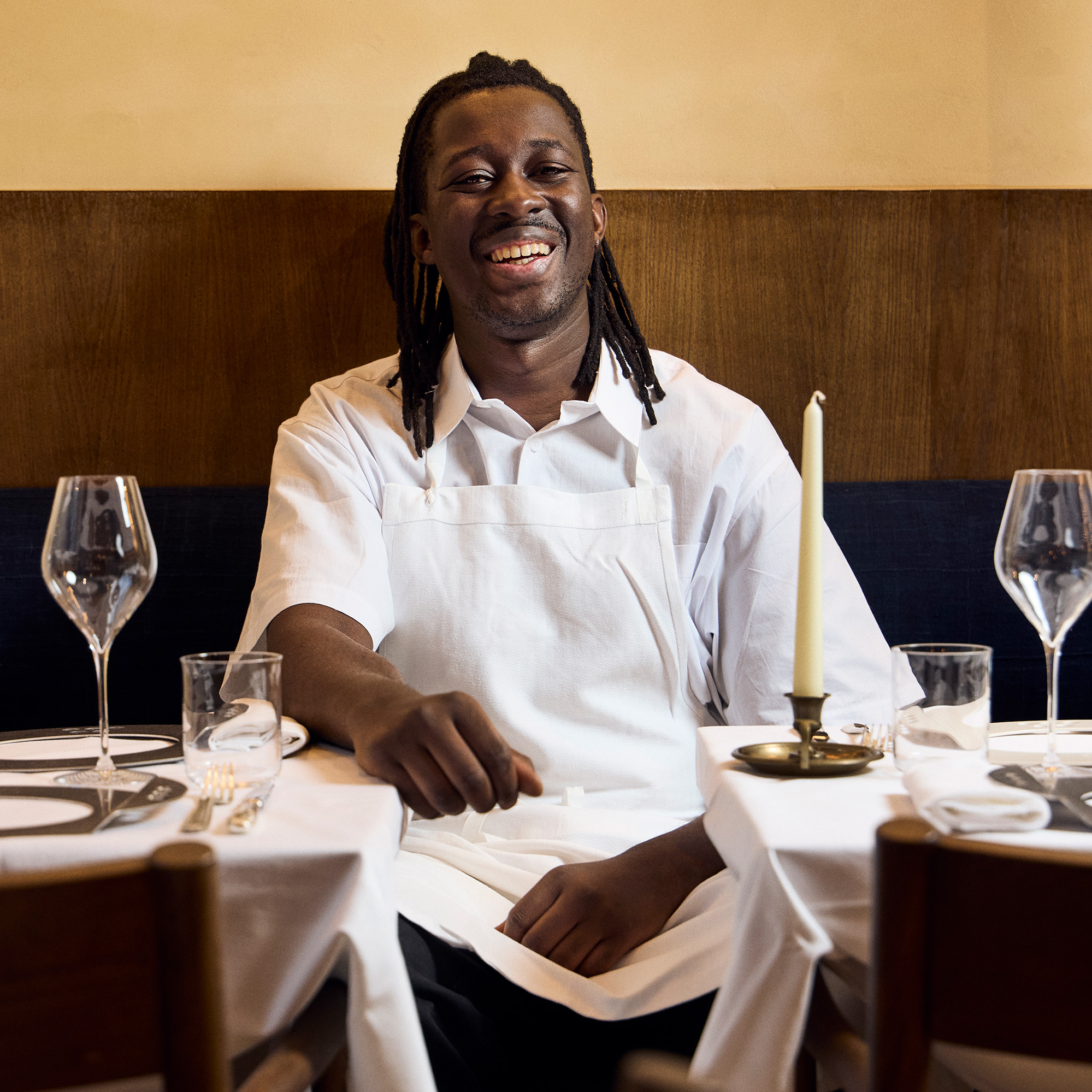
“I’m Not interested in Painting Ideal Bodies”: Emil Sands on the Human Form
With their own unique blend of alluring glances and melancholic scenes, Sands' paintings pour forth from the artist's everyday struggles.
November 25, 2026By
RICKY LEE
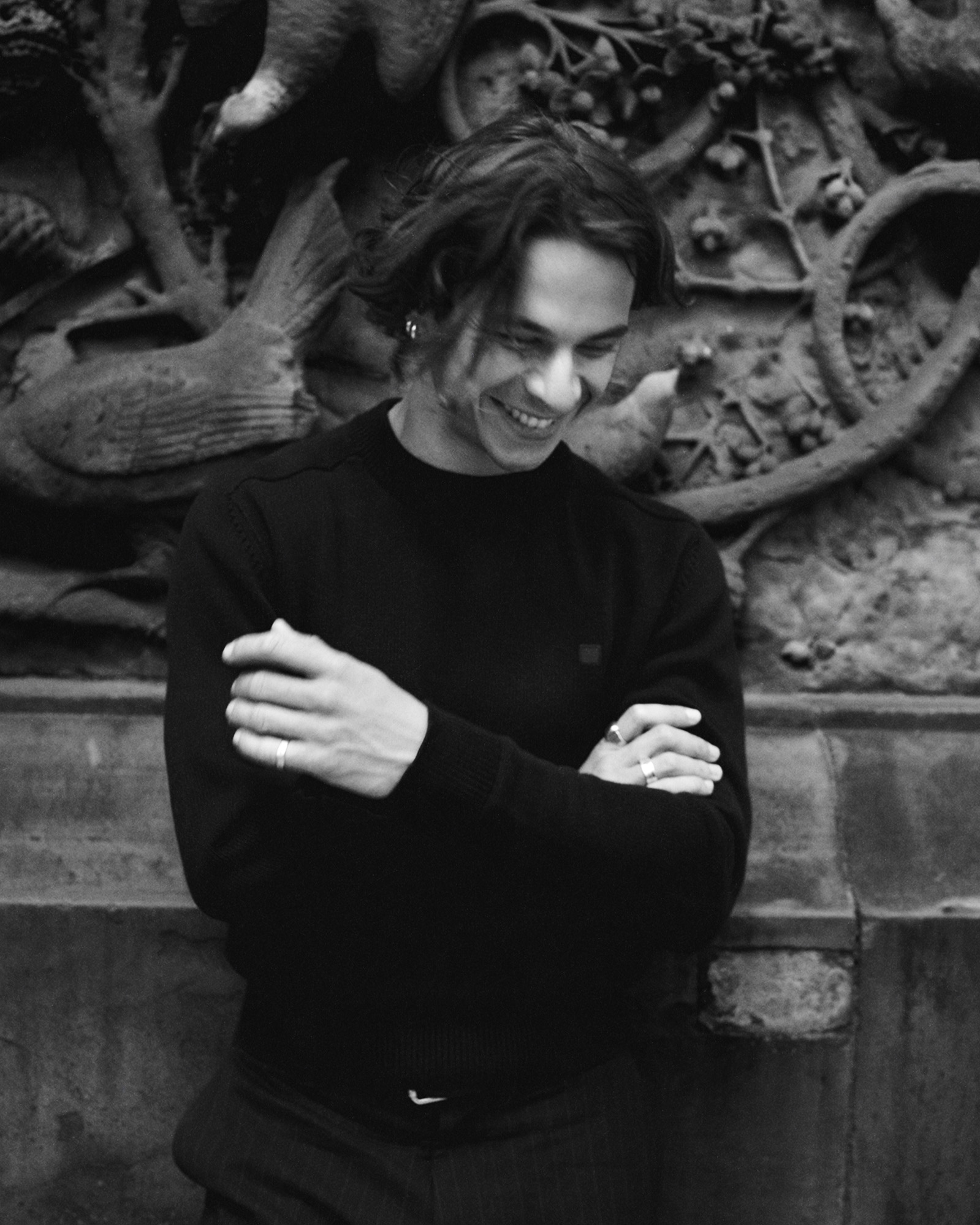
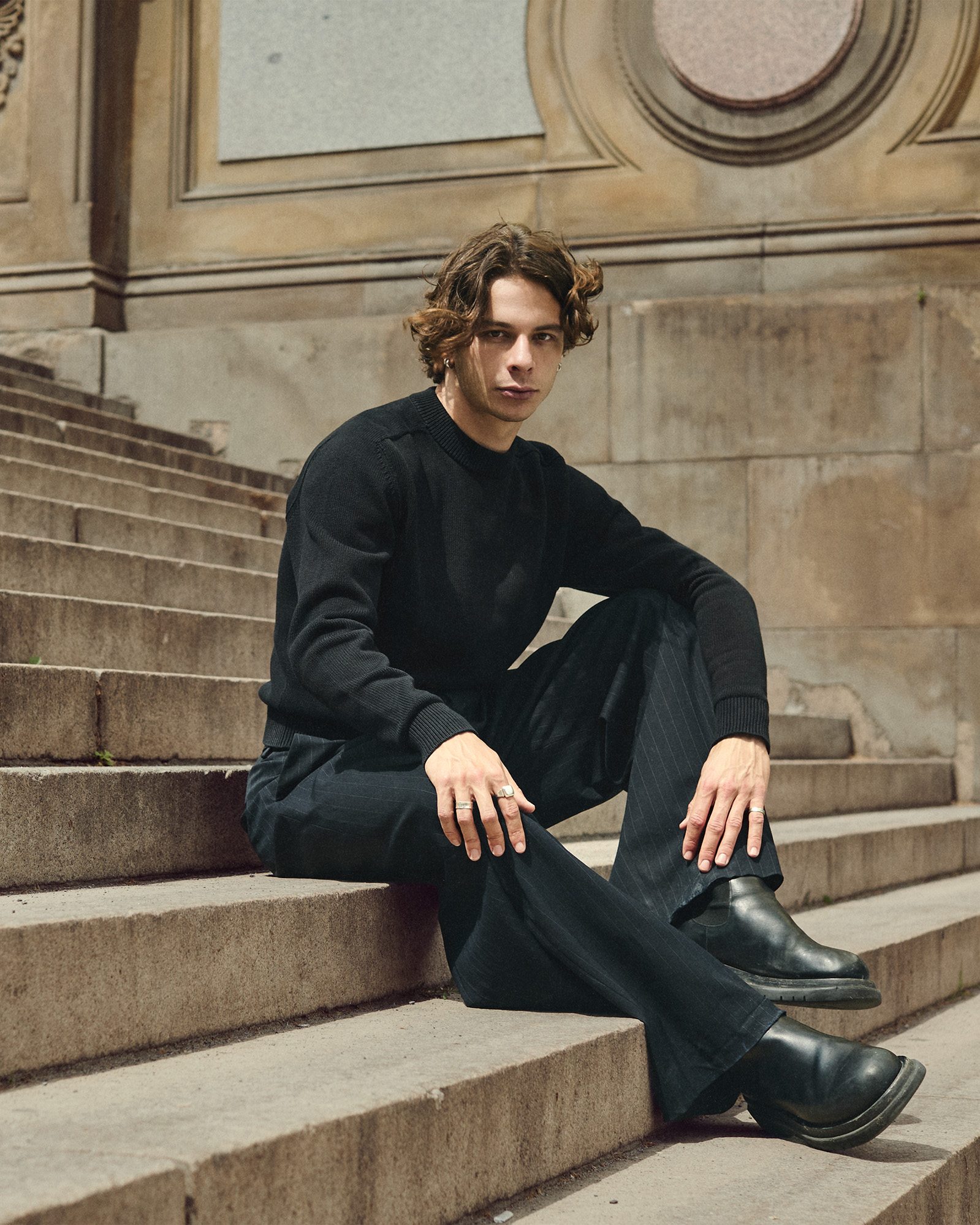
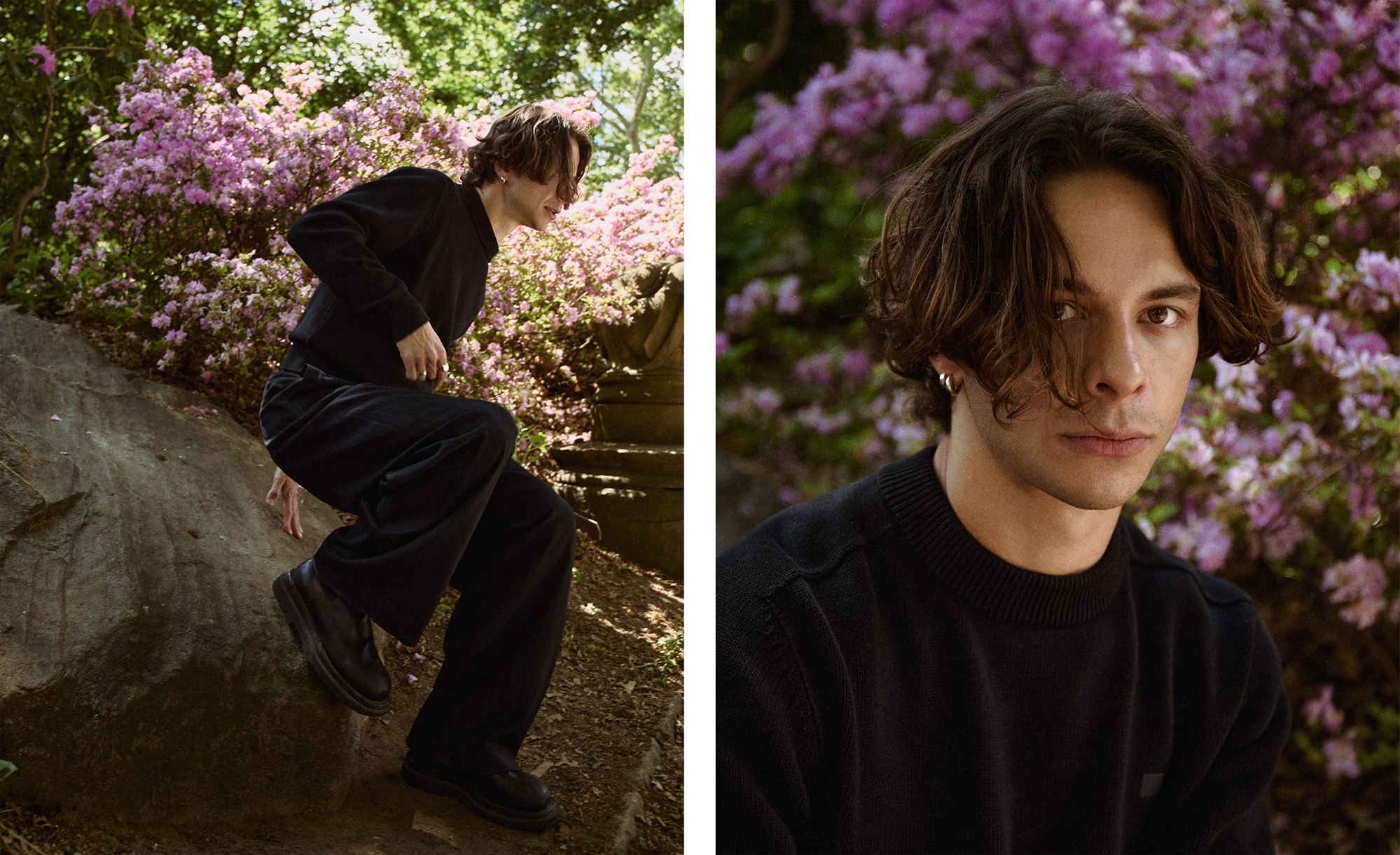
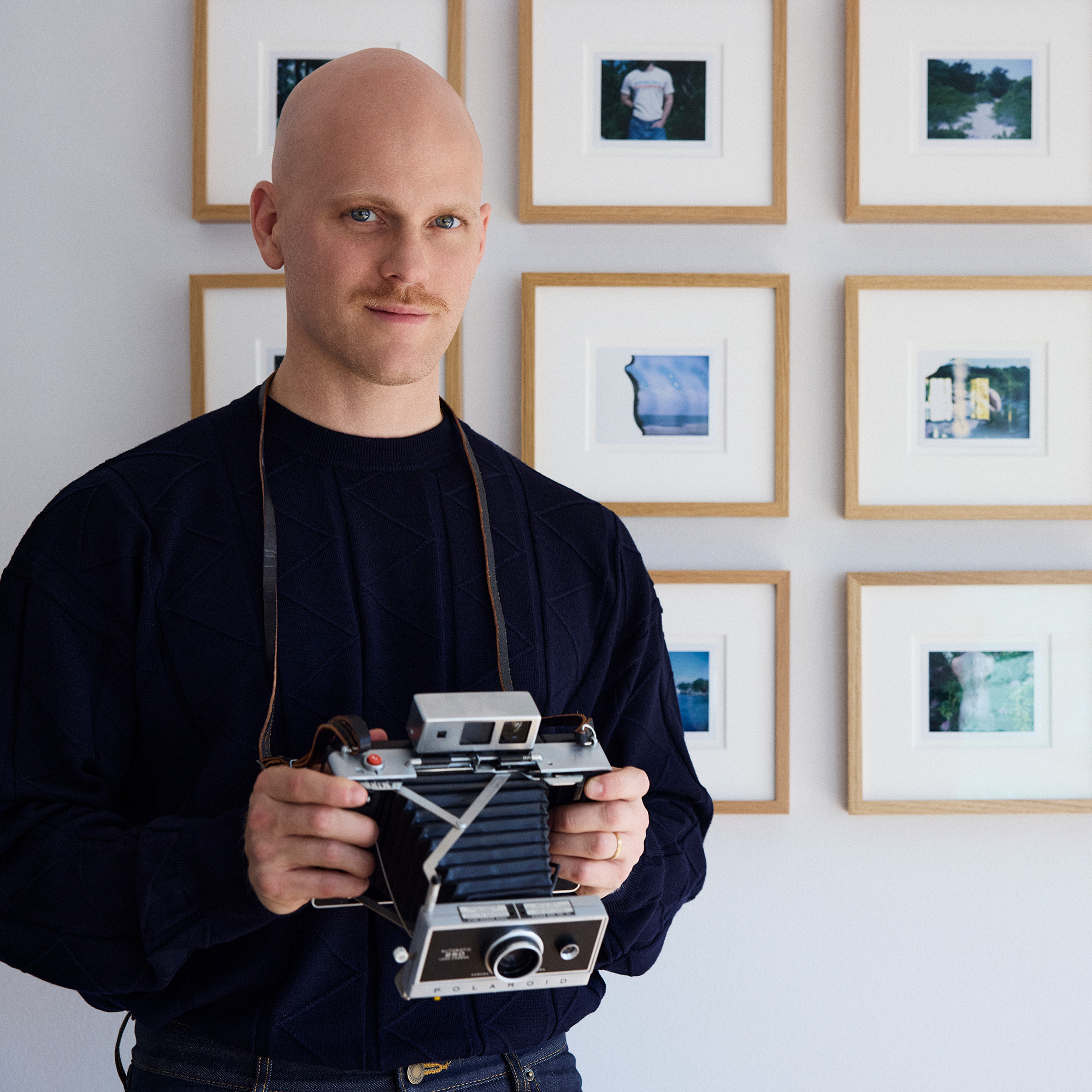
Painter Emil Sands photographed in New York. Sweater and pinstripe pants, Acne Studios; acnestudios.com. Photo: Isaac Anthony
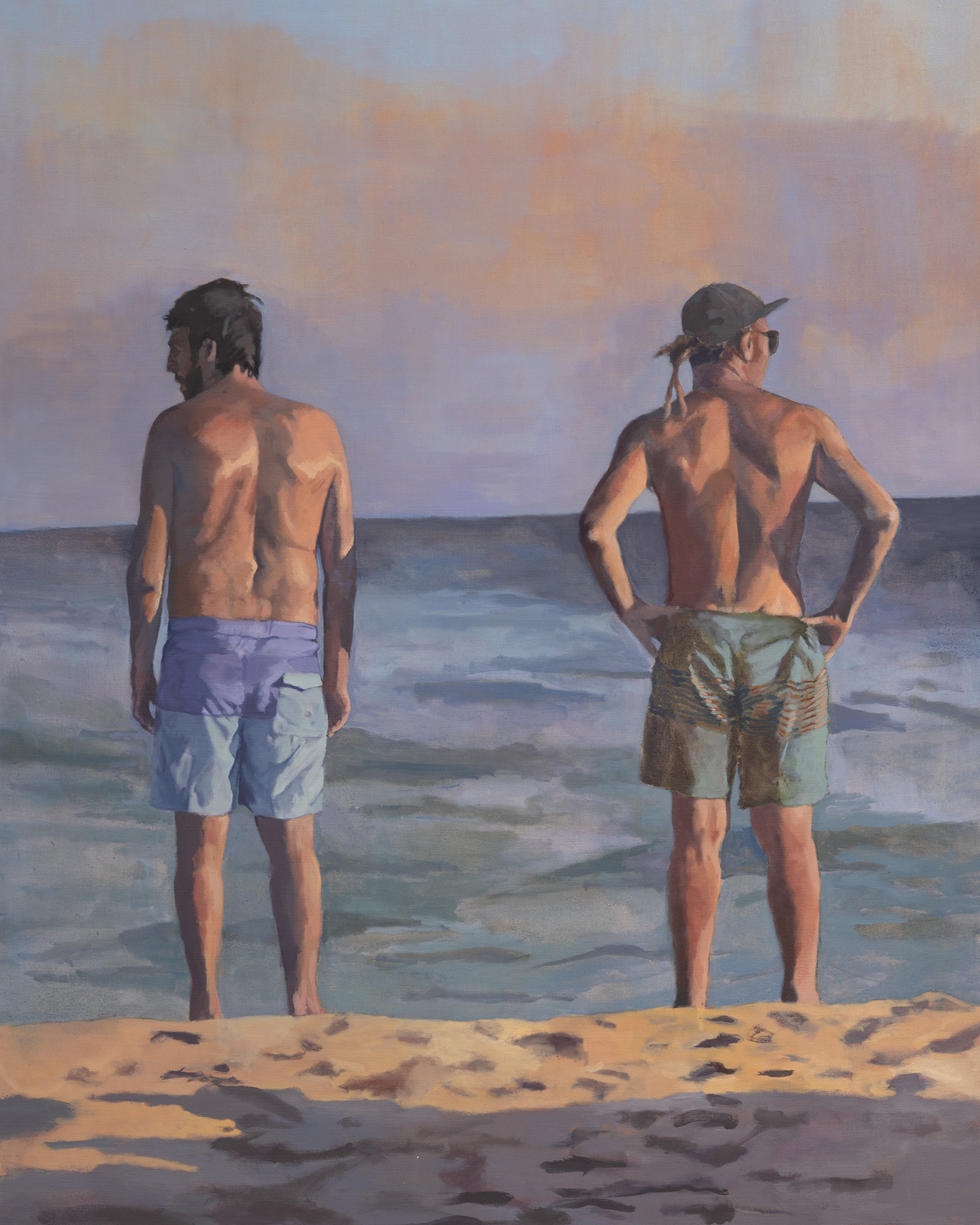
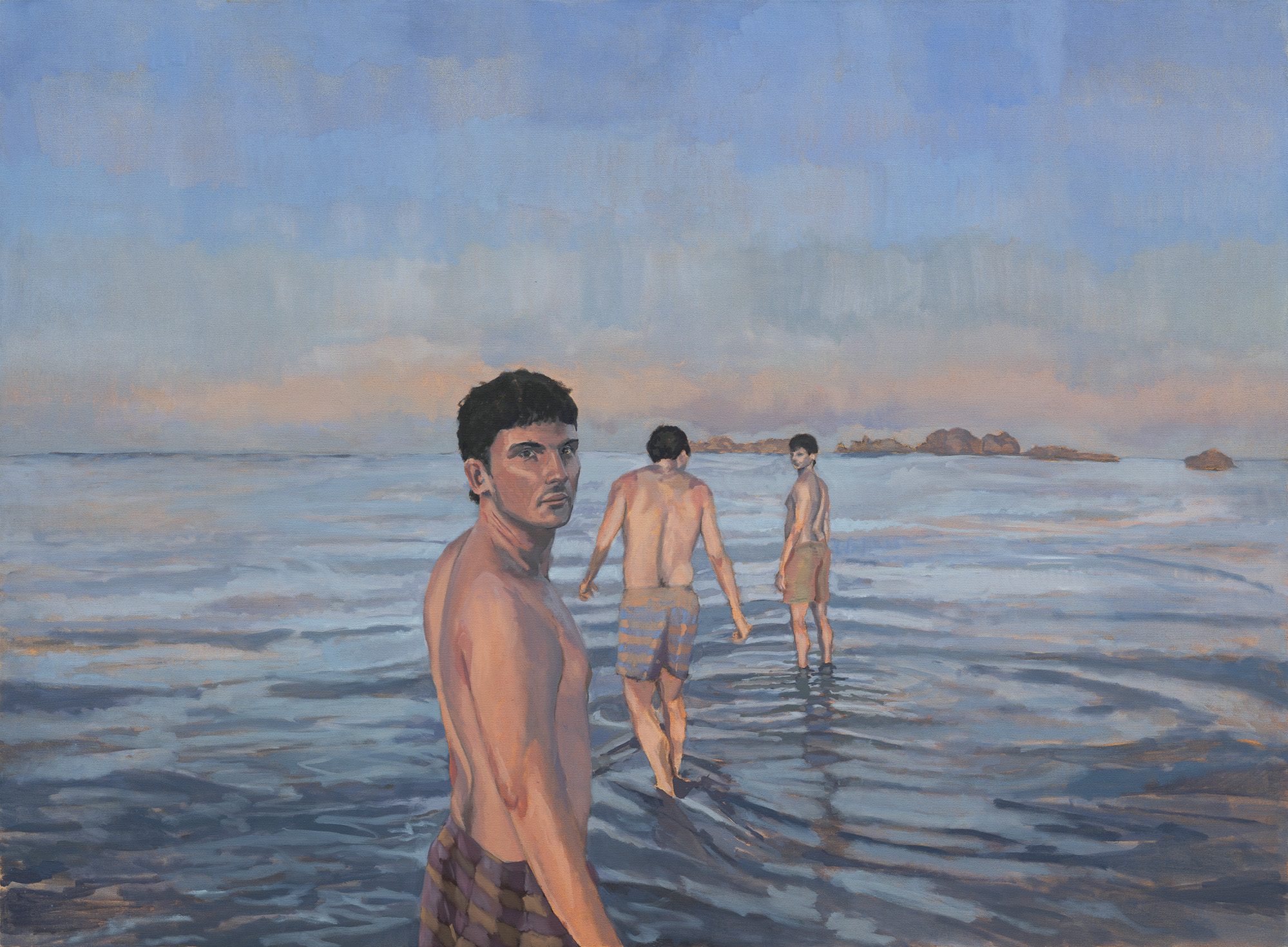
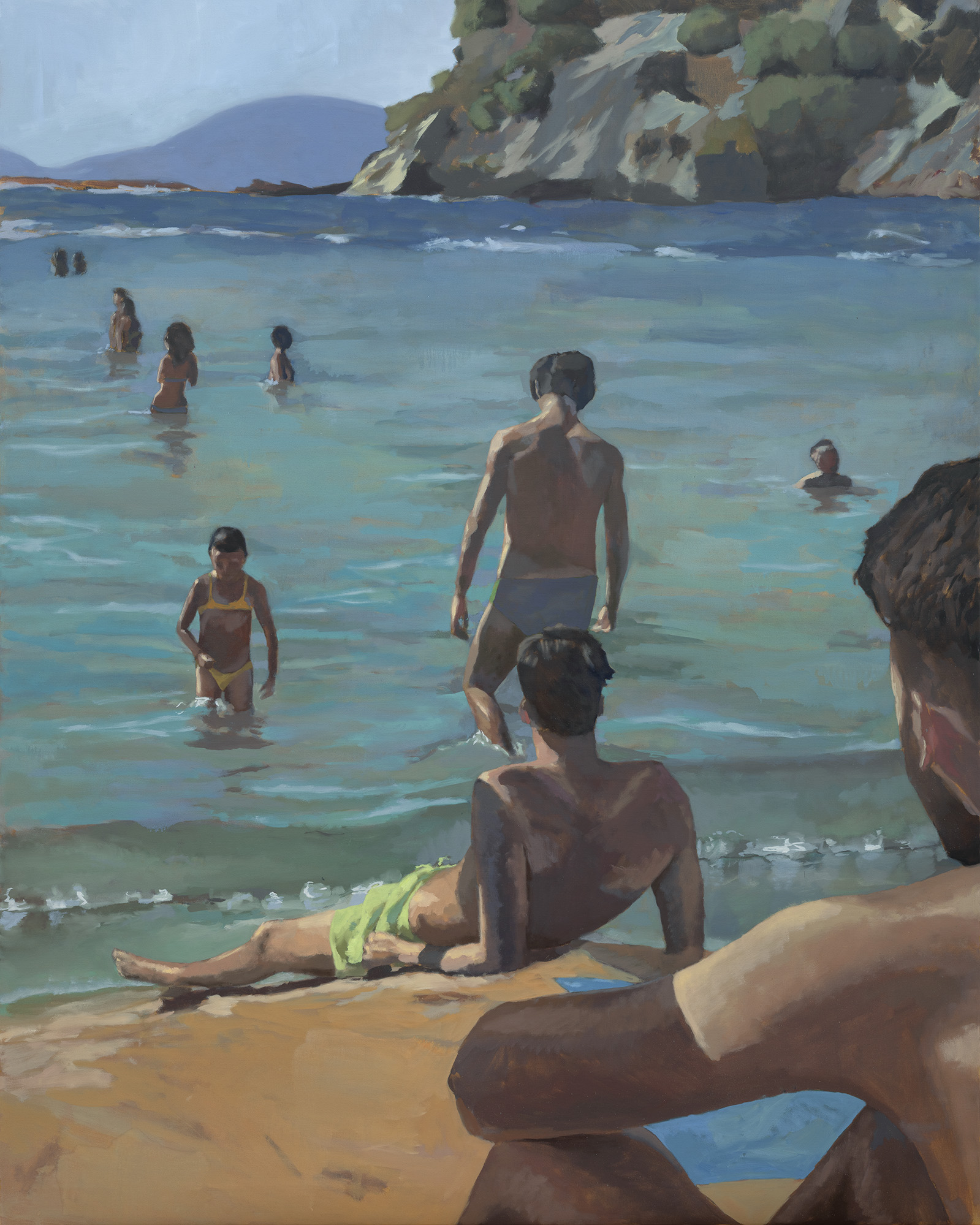
Emil Sands paints bodies in states of exposure. His figures drift through beaches, pools, gardens, and tidal landscapes, often half-dressed or sunlit, their attention directed elsewhere. Even when gathered together, they rarely appear fully communal. A shoulder turns away. A figure stands alone at the water’s edge. The paintings are quiet, beautiful, and subtly uneasy. Rendered in muted, sun-faded tones on raw linen, the works often feel suspended between observation and memory, as though recalling a summer already slipping into the past.
Born and raised in London, Sands attended the foundation program at Central Saint Martins before studying classics and ancient art at Cambridge and later completing a graduate fellowship at Yale, where he wrote the essay that would eventually become the basis for his forthcoming memoir, I Am Not Achilles, which will be published next spring by Scribner and Picador. Ancient sculpture, bodily idealization, longing, and questions of spectatorship all shape the paintings. “After the first year of writing the book,” Sands says, “I looked back at the paintings and they’d become a lot more narrative.”
Much of Sands’s work centers on bodily self-consciousness—what happens psychologically when bodies occupy public space together. “I think you can read my desires quite clearly in my paintings,” he says. Born with cerebral palsy, Sands speaks candidly about growing up hyperaware of his body and feeling watched and medicalized from a young age.
Now 28 and based in New York, Sands is represented by Victoria Miro in London and in New York by Olney Gleason, where a solo exhibition is scheduled for Fall 2027. Last September, he was included in a group exhibition at London’s Thaddaeus Ropac. Increasingly, his paintings have begun moving indoors, shifting from expansive outdoor settings toward domestic interiors that feel more intimate, enclosed, and psychologically charged.
I read your essay on living with cerebral palsy in the Atlantic, and one of the things that struck me afterward was how differently I began looking at your paintings. Issolitude important to the work?
I think one thing that’s very important to my work is the idea of physical exposure. On a very simple level, there are a lot of half-naked people hanging out in these paintings. But on another level, I’m really interested in what physical exposure means psychologically and the kinds of dynamics it creates. If you’re standing on a beach and you’ve got your body out, you’ve sort of prepped and preened and got ready, and you’re thinking about your body in ways that you don’t in other moments of your life. I think the solitude you’re maybe seeing comes partly from that self-awareness. Even in communal situations, there’s a sense of being pulled inward. Also, more and more, my work is becoming slightly different from what I was doing before. The newer paintings are definitely more somber. For the first time, I’m moving the figures inside. The earlier paintings unfold through exposure in public spaces—the beach, the pool, the garden. The newer paintings are quieter and more intimate.
Sweater and pinstripe pants, Acne Studios. Photo: Isaac Anthony
Do you think painting changes the way you look atpeople?
Oh, absolutely. I have a hyperfixation or a hyperfocus on bodies—mine and other people’s. Because of my own challenges with my body, I’ve grown up seeing bodies as entities separate from the individuals who carry them and seeing those entities as signs or symbols to understand more about the people who hold them. What always surprises me is that when I paint people—whether they’re friends, family members, or complete strangers—I always finish the painting feeling very empathetic toward them and whatever their body looks like and whatever their position in life is. That surprised me because I don’t know if I walk around with a particularly empathetic gaze, but over the time I spend painting, I develop a kind of empathy because I feel a responsibility to these characters that I’m creating.
So the figures are characters to you?
Yeah, for sure. My paintings are a whole collage of people I know, figures I’ve seen, strangers that interest me. I’ll sketch someone on a beach and become interested in the way someone’s hand hits their hip or the way two people occupy the same space without looking at each other. Then I extrapolate from that and collage lots of different things together. I work from photographs, from sketches, from memory, all at the whim of telling a story, whatever that story might be. I don’t necessarily know exactly what the story is, but yes, they’re definitely characters—almost like playthings that I’m creating a set for.
Billabong (2024). Photo: courtesy Olney Gleason
Did you always want to be an artist?
I always made art. I’ve always created things. From the youngest age, I had the most pleasure, I guess, and success in making things. I don’t know if I want to draw the tightest link between having a body that didn’t let me be as physical as other boys my age and a desire to make, but at the end of the day, I just always loved it. It was a sphere I felt excited by and comfortable in—the option to make whatever you want and reflect on how you’re feeling was very exciting to me.
Why did you decide to go to Central Saint Martins?
I only did foundation at Central Saint Martins, which is this one-year program in the UK between high school and university that used to be free. It was an amazing thing to have access to at 17 or 18 years old—to suddenly be given studio space and told, essentially, “Go make things.” There was a rigorous application process. You interviewed, showed your work, brought in portfolios, wrote statements. I got into other foundation programs too, including the Royal Drawing School, which in some ways was probably more suited to me because it focused heavily on sustained technical drawing and painting from observation. But when all the acceptance emails arrived, the only one I was genuinely nervous to open was Central Saint Martins. I remember thinking, well, that probably tells me something. So I went there. And then afterward I went to Cambridge and studied classics and ancient art because I genuinely loved it. I never really understood why it should be necessary to choose between intellectual life and visual life.
Water appears in your work constantly. Beaches, pools,expanses of open sea. What draws you to those environments, emotionally and pictorially?
I didn’t actually spend much time around water growing up. I hated swimming. I don’t think I returned to water because of some special trauma related to swimming. It’s probably the opposite. It’s very beautiful. It’s very freeing. It’s this open expanse that maybe I don’t feel I have access to, but can appreciate and think longingly about.
I think a lot of my paintings—for so much naked flesh—contain very little sexual desire. But I think you can read my desires quite clearly in them. Some of them are quite romantic. A lot of the places I paint are places that, as a child and even as an adult, would have made me nervous to be in. Open expanses weren’t spaces where I necessarily felt comfortable. I was pretty scared of the external world because I felt it was coming to trip me up. I’d been so watched and monitored as a child because of my disability. Even now, there’s still a moment before I go into the sea or onto a beach.
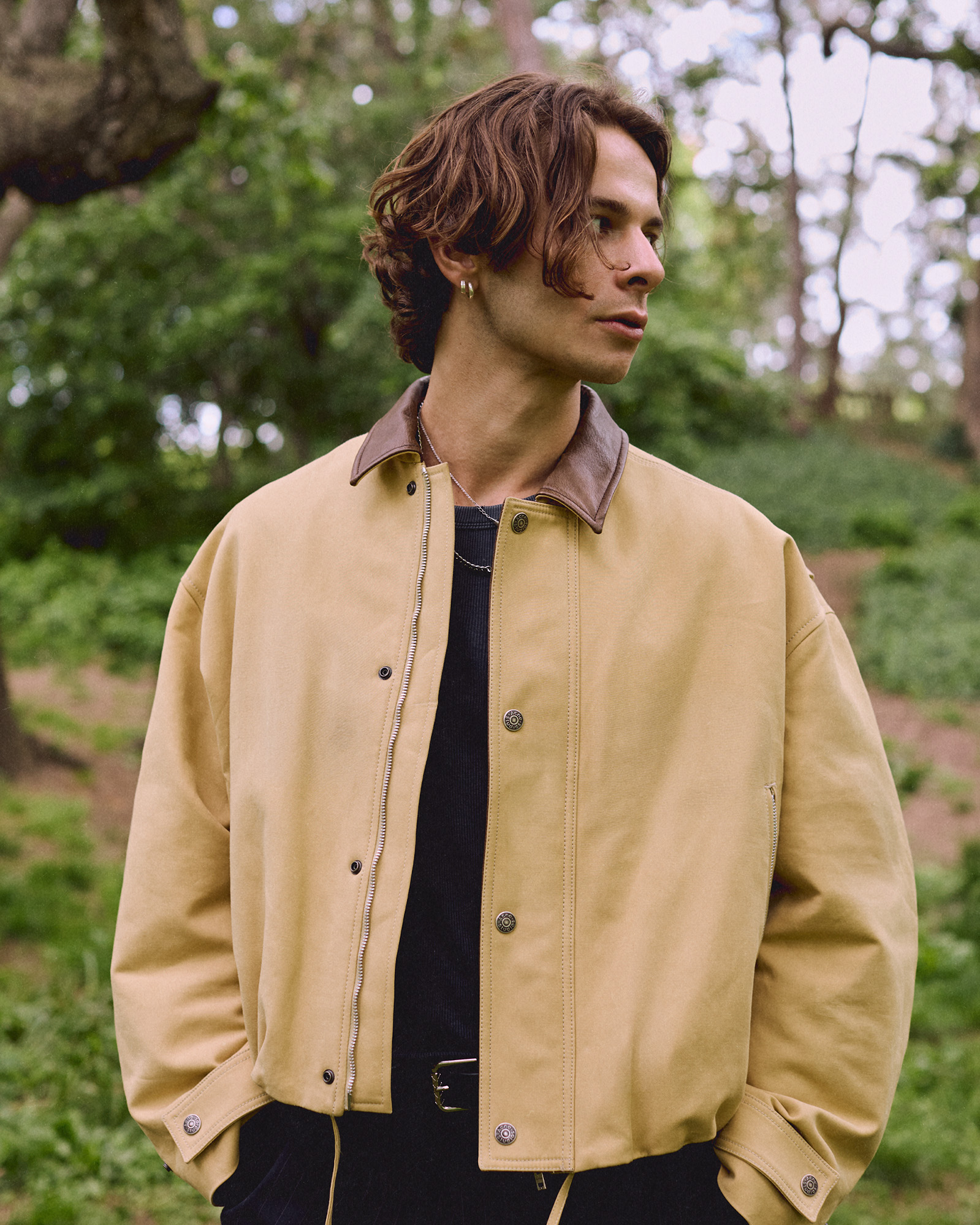
Yellow bomber jacket, Acne Studios. Photo: Isaac Anthony
The figures in the paintings often seem observed ratherthan staged.
Yes. I’m really interested in observed moments. I think my paintings are attempts to convey perspective—my perspective—which has always involved watching people, seeing how they interact, seeing what about their bodies I like or don’t like or could copy or ape. A lot of my paintings are figures painted from the back because I spend a lot of time watching people from the back. That’s when they can’t see that I’m seeing them and watching them. It’s always a bit nerve-racking when someone is staring directly back at you. But when you’re given free rein to look at someone, you take it.
I quickly understood that the incidental moment is more interesting to me than something overtly staged. Someone standing there with their head down, maybe reflected in water, having some quiet internal moment—I don’t necessarily know what they’re thinking. I’m not there to answer that question as much as provide it. I like the voyeurism of the work because it’s very true to how I see the world.
You studied classics and ancient art at Cambridge after Central Saint Martins. How does that history of the idealized body reflect in your work?
One reason I loved ancient art as a child was because I immediately understood that there were people 2,000 years ago thinking about bodies as intensely as I do—not only about having one, but what it means to have one. The idealized body might seem oppressive for someone like me who doesn’t have an ideal body, but actually it’s been the opposite. It became an invitation into that conversation. With so much emphasis on beauty and perfection, whoever made those sculptures isn’t so different from me. We’re both interested in who gets to have beauty and what it means to have it. Ancient sculpture uses the body to signal goodness, ugliness, morality, status, power. The body becomes a social language.
I would love to pretend that our bodies mean nothing and that we’re above them and it’s all about our minds and psyches, but that’s not the case. The body signals something about who you are, what kind of person you are, and where you’re situated in society and the world. I’m not interested in painting ideal bodies, but I am interested in using the body as a way to convey messages about the world around it. I’m interested in thinking about what putting two different kinds of bodies together means. What do two bodies that physically mimic each other say about their relationship?
Aldo’s Dream (2025). Photo courtesy of Victoria Miro
Is there such a thing as an ideal body to you?
I don’t think I show myself the same respect I show other people when I think about bodies. I know my body doesn’t work how I want it to. Because of my cerebral palsy, my right side does very little. It develops muscle in a very limited way. I have a lot of dexterity issues. I can hardly pick up a cup with my right hand, and I’m right-handed.
Being classed from a young age as physically abnormal—being hospitalized and medicalized and corrected—made me covet the idea of normalness.
I don’t necessarily covet outstanding beauty, although of course I’d love it for myself. But normalness is something that lives in my brain. If, as a child, you’re constantly being medicalized and measured and corrected, even for good reasons, it inevitably shapes how you think about exposing yourself physically in the world. I’m grateful for all those things. I wouldn’t have the body I have today without them. But I’m also not going to pretend they don’t come with their own psychological baggage.
What is normal?
I have very vague notions of what normalness or beauty even are. The only thing that doesn’t feel vague to me is the understanding that I’m somehow outside them.
You work seriously both as an artist and as a writer. What does one give you that the other doesn’t?
Honestly, I love doing both. I split my day equally. I write in the morning and paint in the afternoon. Both bring me huge amounts of joy. After the first year of writing the book, I looked back at my paintings and realized they’d become a lot more narrative. They became much more filled with stories. That makes sense to me. If I’m delving deeply into storytelling on the page, of course that would begin appearing in the paintings too.
Also, writing so intensely about myself, my body, and my feelings toward both of those things over the last few years—well, to put it very simply in a very American way—[switching into an exaggerated American accent]—I’ve been on a journey.
Sweater and pinstripe pants, Acne Studios. Photo: Isaac Anthony
How so?
I know the parameters of myself better than I did three years ago, and that no doubt helped my painting. Writing the book was an extremely intense way of doing that kind of self-exploration, because suddenly it wasn’t just private reflection anymore. It became a many-thousand-word object with a deadline attached to it. But it helped me emotionally and personally, and definitely helped the paintings too. I suddenly understood more clearly why I was painting all these bodies, why I’d spent my life looking at bodies so intently, and why exposure mattered so much to me psychologically. There’s no single neat answer to those questions, but remaining on the track of asking them has become very important to me.
Your paintings are beautiful, but there’s also a sense of unease in them.
I think that unease comes from exposure. I know very few people who can take their clothes off and truly not think about it. The second someone else is present, there’s risk involved. For me, the risk is judgment—someone looking at me and thinking they can see things about me I don’t want them to see. Everyone brings their own baggage into exposure, and I think that tension is what gives the paintings their emotional charge.
In my Venice show at Victoria Miro, I introduced sculpture into the paintings. In one painting, All Day Duchess, there’s a woman beside a swimming pool and, in the foreground, the broken corner of an ancient marble bust. Suddenly the painting becomes not just about one body looking at another body, but about a contemporary body existing in dialogue with history, beauty, power, wealth, classicism—all these things already embedded inside sculpture.
You mentioned the newer paintings are moving indoors.
For the first time I’m painting figures inside—by windows, in domestic spaces, with paler light and less of that warm summer glow. It feels like a natural progression from the earlier paintings. The earlier works begin with figures publicly exposed at the beach, then move toward more enclosed spaces like gardens or pools, and now they’ve entered domestic interiors. They’re the same figures. They could have just walked inside from outside. The interiors change that dynamic completely. The exposure becomes quieter and more intimate. My dad always says he loved the earlier paintings because he could feel the heat coming off them, like summer. These newer paintings don’t have that same warmth. They have another emotional atmosphere entirely.
Do you think the work is making a comment on masculinity?
Oh, for sure. I don’t necessarily know exactly what the comment is, but masculinity is central to the work. Having a body as a man is complicated. Having a body at all is complicated. I realized while writing the essay for the Atlantic that I carry a lot of shame and worry around with me. I don’t think I fully understood that before writing it down and seeing it as this contained thing outside myself. I think exposure is vulnerable. That’s the key thing in how I think about these works. I do try to capture vulnerable moments. I feel like I’m quite a vulnerable man myself.
Are there particular colors you’re drawn to?
Yellow is very hard. I don’t necessarily have a color I love, but I find yellow troubling, and green too. One thing that characterizes my paintings is that they’re kind of washy. There’s a nostalgic quality to them. I paint on linen rather than canvas, and I prime it with a transparent agent that allows the dusty camel color of the linen to remain visible underneath. I like that because it contributes to the feeling that you’re looking at a summer that’s already passed.
Are there particular writers you’re drawn to?
Alan Hollinghurst, absolutely. He’s my favorite writer. I actually named a painting in my Venice show after him. I’d just reread his novel The Line of Beauty while I was in Venice making those paintings. I also recently reread Patricia Highsmith’s Talented Mr. Ripley. Both works are about wanting something you’re not necessarily allowed to have. That feeling interests me enormously—the emotional structure of longing itself. I think a lot of my paintings are really about wanting access to another kind of life or another mode of being. That sits underneath the work quite consistently. Hollinghurst understands that beautifully. Desire in his novels is never just sexual desire. It’s social desire, aesthetic desire, aspirational desire. I think my paintings operate similarly in some ways.