From hotels and boutiques to furniture and tableware, Urquiola has been a defining influence on design in the 21st century, and serves as art director of legendary Italian brand Cassina.
November 2, 2026By
THE GRAND TOURIST
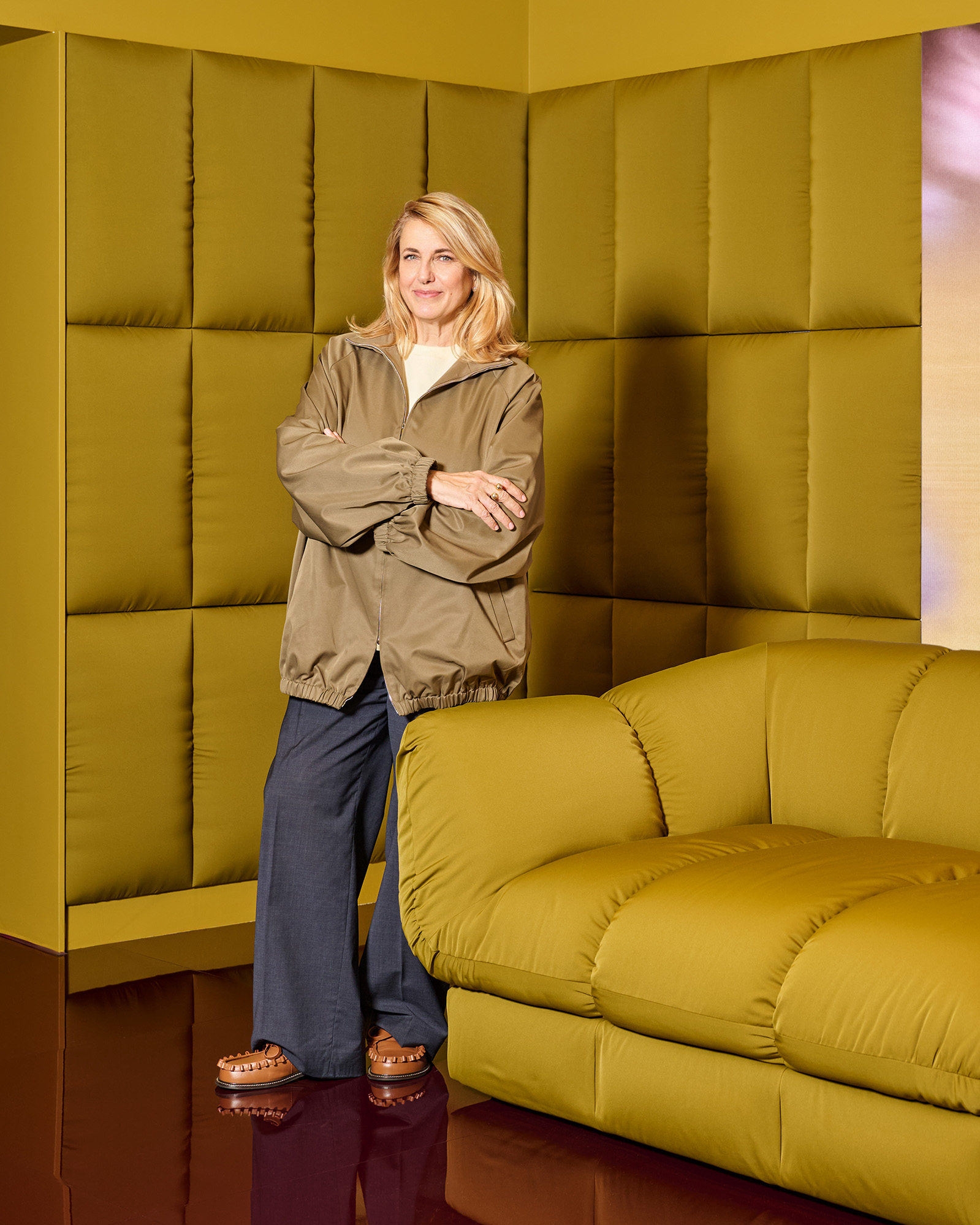
Patricia Urquiola, art director of Cassia, with the Ardys sofa system. Photo: Valentina Sommariva, courtesy of Cassina
SHOW NOTES
From hotels and boutiques to furniture and tableware, Patricia Urquiola has been a defining influence on design in the 21st century. In this episode, Dan speaks with this prolific talent and art director of the legendary Italian brand Cassina about her early life, how she avoids trends, and how she is definitely not “chromophobic.”
This interview originally aired in season one of The Grand Tourist podcast on July 14, 2021. Its transcript appears here for the first time as part of The Grand Tourist Classics, our ongoing series bringing conversations with tastemakers in fashion, design, food, and travel from our archive to the website.
TRANSCRIPT
Patricia Urquiola: It doesn’t make so much sense to use a Mac from the 80s if you are not in an art installation. But it makes perfect sense to sit in a 2021 version of the Afra and Tobia Scarpa Soriana armchair of ’69, and the revolution. The timing of products is a bit longer. We have to defend, as in music you know, a classical opera or something, we have to reproduce in the right way, or we have to grow with them. This is a very interesting thing, I think. I want the new generation to kind of preserve those items in the case of my work with Cassina, for example, it’s part of our work. It’s the beauty.
Hi, I’m Dan Rubinstein, and this is The Grand Tourist. I’ve been a journalist for nearly 20 years, most recently as the Home and Design Director at Departures Magazine. This is my personalized guided tour through the worlds of fashion, art, architecture, food and travel, all the elements of a well-lived life.
It’s hard to imagine what the world of contemporary design would look like without the influence of my guest today, Patricia Urquiola. Since starting her own studio in Milan in 2001, she has left an indelible mark on design. In a world dominated by men and a kind of dour seriousness, Urquiola arrived on the scene with works that embrace color without being garish, organic curves without being impractical, and a sense of friendliness that is anything but silly or frivolous. Not only is Urquiola a woman, her Spanish roots are evident everywhere in her work. Today her firm designs products for the home, from beds to cookware, as well as interiors and architecture for everything from yachts and hotels to luxury watch showrooms and Museum installations. Her client list is a who’s who of the most progressive and demanding brands including Moroso, Flos, Kvadrat, BMW, Boeing, Louis Vuitton, Missoni, Mandarin Oriental hotels, Four Seasons, Marriott, Starbucks, Ferrari, and Swarovski.
In 2015 she was named art director of the legendary Italian design brand Cassina, more on that later, while continuing work on her own practice. First, a fair warning if you haven’t had your coffee yet today, pause the podcast and take two shots of espresso before continuing. You can’t be as prolific in the world of designs of Patricia Urquiola without having metric tons of energy. I chatted with the master herself from her studio in Milan.
Tell me about your early life. What was that like?
Well, Oviedo, where I come from, is a city in the north of Spain, near the Atlantic side. I’m not Mediterranean. That’s an important thing to say, because in the north of Spain, there was the Cantabrian Sea, which is part of the Atlantic. It is a very powerful place with a kind of change in weather, where climatic arguments are always in our conversation. I think it’s important to explain. I speak a lot now, and I didn’t when I was younger. I was always with short hair because I was moving too much. I was always doing something or getting dirt or doing something that they didn’t know well. Playing with my doll house, which was a doll house with a rationalist attitude, not Victorian.
You had a modernist dollhouse.
Yes! It was green like this color with terraces and a flat roof. It is very interesting. I think when I was a teenager, I decided to be an architect. That I remember. My brothers would say, oh you’re going to be this or that, but me, I had this idea perhaps it was a young idea of what I could be; I was good in math. And I wanted to do something creative. Architecture for me was something with a big A, very interesting.
You trained under some of the greatest masters of 20th century design like Castiglioni and Magistretti. What was it like working for them, what did you feel you learned from that generation of post-war product designers from Italy at the time?
The Politecnica in Madrid was really interesting too, you have to imagine me, I’m a generation that was the one after Franco. When I was young, he died, and then in Spain, all of Spain it was like we were all doing evolution, evolving in an incredible way, a kind of idea of getting each of us a new freedom. Then when you get older, you understand this concept of freedom is a little bit more complex. The idea that you could kill the other kills the father, this idea was super important and possibly part of my attitude was moving somewhere else. My comfort zone was too much, and I needed to move to a new comfort zone. I think coming so young to Milano that sort of happened to me because I had to re-adapt to a new place. It was a place where things were a bit more complex. I was a woman, and I was a Spanish student in University, and I was one of the very few ones. You had to find a way, and you had to adapt to the circumstances and I think that was very interesting.
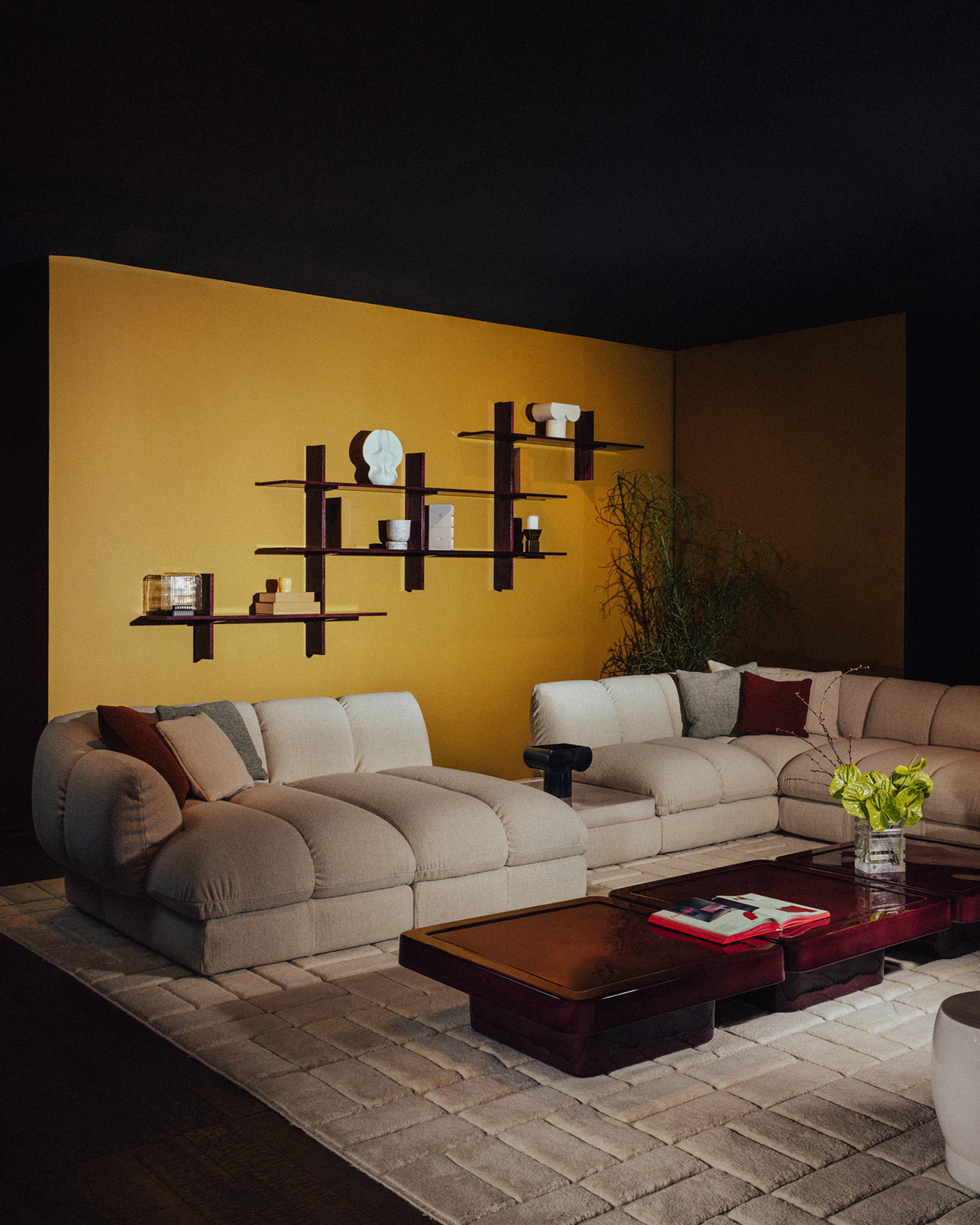
The Ardys collection, designed by Urquiola for Cassina. Photo: Courtesy of Cassina
Was it hard to be a young designer in the 90s when there were so many masters still present you know what I mean? Was it hard to compete against?
I think perhaps the daughters and sons were more like this, the Italian generation. I think me coming as a foreigner, and coming from this as I was saying, a new generation, we were really open. It’s very important how you come to education in your life. How now we are all thinking about our children, and younger people to make them understand this is something we have to learn from. At the same time, we need to understand that we’ve been suffering a lot and we need to grow, do a new passage to grow through these circumstances. For me I think I was a bit helpless from that side, perhaps yes, perhaps not. There was even Fiorucci, we don’t have to forget Fiorucci. It was the concept of the strict life coming through anything. The way of thinking. It’s very interesting, there were many other circumstances that were born partially in Milano. Things that today are an element which is very important to understand many things and how we are evolving.
When you first started your own studio in 2001, what was the first piece you designed that went into production? What was the first thing you remember was your first real project to have your own studio?
I opened my studio at a certain moment when I was getting into the 2000s, the millennium. I think for me it was an important moment of change. When I opened the studio, I had already done a collection of armchairs with a friend who was working with me in the studio of Piero Lissoni. That was a very nice experience too. For example, there I can tell you the lesson of the 90s. I was telling you, more my period in the 80s, but in the 90s, we have to remember that working with Piero was a strong relationship with Giulio Cappellini. And in that period, Giulio had a strong new attitude to be open to designers not from Italy.
Giulio Cappellini, yes, who has his own future brand Cappellini, known for making rock stars out of many young designers both Italian and not Italian.
Yes. and making them became part of the Italian design system. Adopting them from other countries and enlarging the page. I think Giulio had this enormous fantastic view that he would grow the system, but be even more open to the world. Having an enlarged point of view. When I opened the studio, I thought I had done this work in between before. When I opened the studio, the help was Patrizia Moroso. Moroso was another company that was not part of Lombardy, the place where Milan is, it’s from another region in the north of Italy. But there was a woman who was very open minded before, as Giulio Cappellini, and she was having conversations with different people. I had the luck to make her see a little prototype of a felt, a type of sofa with movement that I thought nobody would listen to me. It was done for another company, I won’t say the name but it was a little company, nothing nice, and a friend of mine saw the pieces and said I want to show it to Patrizia. There was this connection with Patrizia, and then they said we’ll do it. And I began to work. Perhaps my first pieces with her put me on the spot, they gave me a voice. I really say thanks to this person that believed in me in my beginning.
(SPONSOR BREAK)
In 2015, she joined Cassina as art director, and was recently renewed in her role. What makes Cassina so interesting to me in the context of Patricia Urquiola is that she produces both contemporary pieces as well as 20th century icons from the likes of Charles Rennie Mackintosh, Charlotte Perriand, my own coffee table, Frank Lloyd Wright, and Le Corbusier. While she’s a keen defender of the classics, she’s also got her work cut out for her with the brand that has to evolve in the twenty-first century, with things like sustainability and the new post-pandemic reinvention of the world of home and work.
To those listeners that are not familiar with Cassina, how do you describe the brand to them? If you meet someone for the first time who has never heard of Cassina before, what would you say? How do you describe this legendary brand?
Cassina is a company with elements of heritage, a company in design and lots of design during Italy in the 50s, and now has an archive of 600 pieces. Just to make you understand.
That’s huge.
600 pieces which is fantastic. It’s something you can get lost in. It’s a company that’s always had a strong will to research and innovate. Which is another really important thing to say. Working with architects and designers, as well as re-editions of design icons. So I think Cassina’s identity is strongly linked to technical skill and craftsmanship. And with almost 100 years of history, we are going to arrive at 100 years in a very short time and we did the 90th anniversary that was a very important anniversary a few years ago. I hope we are still able to innovate.
And Cassina, like many of the great design brands, has both completely new products but also re-additions and classic pieces that have been produced years ago. Is there a particular designer in the archive that Cassina still produces that is your favorite? Or one that you identify with personally as a designer?
I think the work of, not one piece, but the work of Charlotte Perriand. Because she came inside with her energy from work. I think we discovered at the time the big energy of her. Her interpretation of nature and material is really interesting.
When someone is looking at a piece of furniture that you’ve designed, how do you think someone can identify a chair or something and say that’s an Urquiola piece. What are the essential qualities?
What I’m going to say to you is going to be a lot different than what people do.
No, I want to hear your opinion.
I think the perception of myself, I’ve always been very open to listening, it’s very different. People that were picking up on an energy of me that perhaps I didn’t perceive so well. But I think for me, the first thing is surely that I try what I do is an experiment or an approach to matter and research, but at the same time I’m always trying to interpret in an intuitive way a collective taste.
It’s putting together this experiment, let’s say, but always connected with an intuitive attitude and understanding what I take as part of my idea of collective taste. I think that for me that is important when I’m trying to do something. I think another thing could be, for example, can be searching for mental comfort in the user and trying to adapt what can be new behaviors, then to have a mental comfort in relation to what you do means that your are understanding, or you are trying to understand the way behaviors change.
Another thing that is important for me in my work is being empathic with the people I’m working with. I’m a person, I know people are coming to me when it’s a new company. They say we know you, even if you don’t know the technology of that kind approach, you are going to be very open to do that kind of work together. For me it’s very important that they come understanding that. I think if I look part of my process, mental process is working through my analogies and emotional memory shortcuts that I have, that I put in my approach to culture, my own culture, emotional elements which I have in my memory. They come through and they come out in many projects. I’m not sure if these are things you think when you see them! Your perception is part of you. It’s not important for me. This is my way.
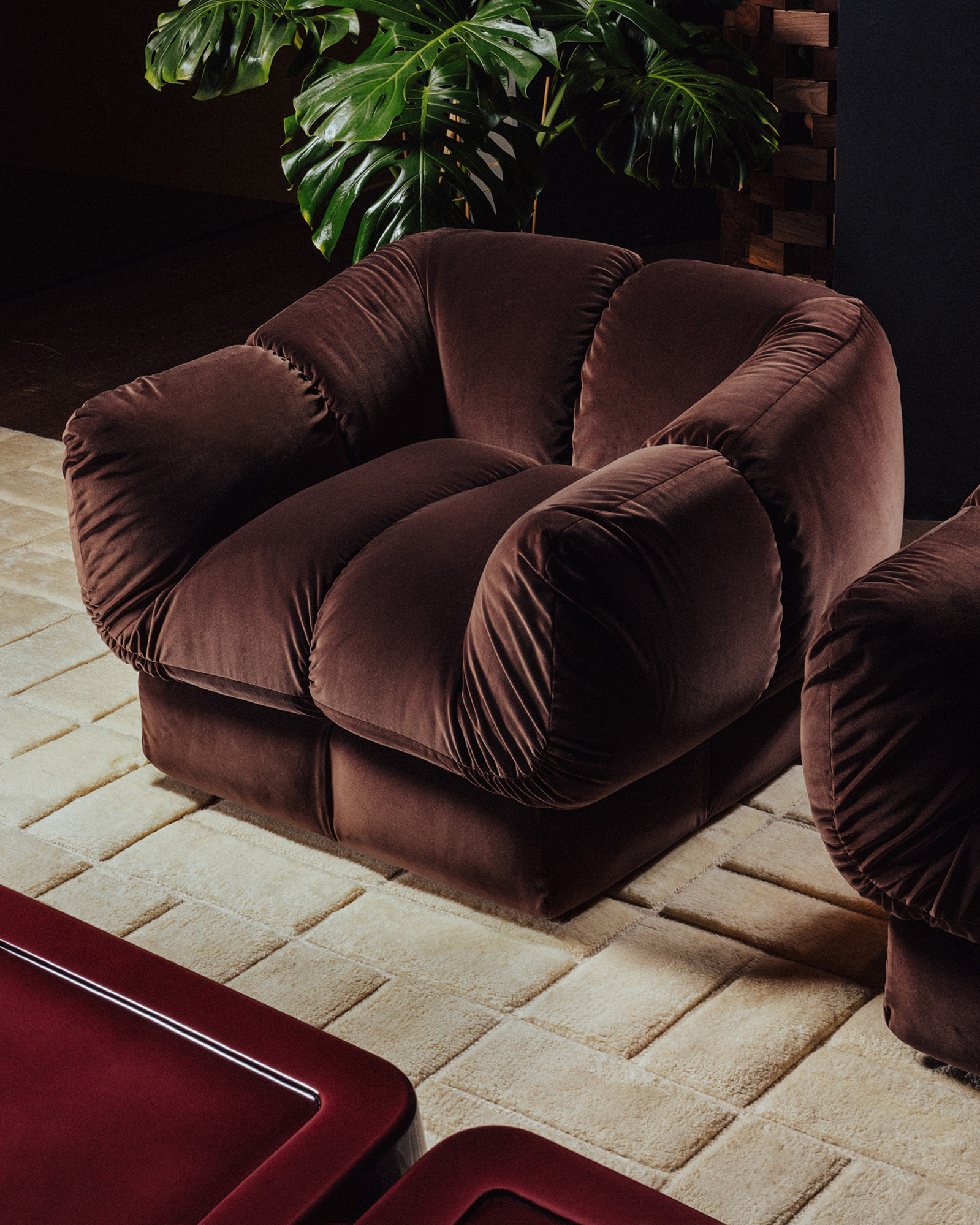
The Ardys armchair. Photo: Courtesy of Cassina
Speaking of energy, there’s a lot of focus now in the world of design on the outdoors and outdoor furniture, living outdoors, cooking outdoors, especially now. It was becoming more popular before but especially now with the pandemic even more so. What is your outlook on designing for the outside?
I have no more energy. I think coming from the Atlantic, we go to the beginning, it’s a good thing. We can connect, circularity, I think is one of the words that helps us to think. Circularity with our conversation. I am Atlantic and I come from a place where the conditions when you were inside or outside are changing a lot. When you are outdoors, not inside like the museum, then you cannot create your own world and control it like when you are inside. The relationship with the climatic elements that are part of our work are much more present. It’s nature in a very enlarged way. It’s not only physical, it’s the way we breathe, the wind, the sun that is modifying the materials we are using, and we find a way to do it in a much more profound protective way. We use a product that can resistant outdoors. At the same time, we find we need to find a better way or metrics to understand this. I think even in that argument, which is speaking about outdoor pieces, I think I’ve learned in the last few years how to be more resistant and more resilient because they are in condition. They are even related directly with any kind of natural element. At the same time, more and more, the conversation has to move to making them possibly with new technologies or biotechnologies. How to make them resilient but in a way that is different than how we were conceiving in our material world. I hope we can live, work and do a lot of things outdoors as human beings and more connected to outdoor spaces because you are in a less controlled environment which is a beautiful thing. We have to learn how to use the tools for living in a better way.
You mentioned you have to understand the sort of the collective taste, and you have to kind of create something that is both new but also recognizable, that pushes boundaries but not too much. Is that fair? Is that what you mean?
I think it’s not pushing boundaries too much, because you don’t know. You never know when you are doing a product that is going to be introduced. I always like to say to others how brave the people defending companies that have a certain quality are. It’s a process of one, two, maybe three years. And then you introduce them, then people have to understand them, they have to go on the market, and it’s not like fashion where perhaps you don’t understand what’s in this moment. And perhaps you have a response, maybe it’s good or dramatic. In our way of doing, if you’re not understanding something, or you’re not connected, perhaps you understand that it’s not working after two or three years. The dark side of you work comes out slower.
For people that don’t know, in your world it takes three years to produce a piece essentially.
From the scratch, from the idea. I see the idea is working well, or sometimes it’s four years, two years. It’s a lot of time. One year for producing the thing. Minimum two years. A minimum.
So, you can’t do anything too trendy, nothing too trend focused. By the time it actually is sold in a showroom or arrives in someone’s home, it’s three or four years later and three or four trends have come and gone.
(SPONSOR BREAK)
It’s impossible for me to neglect the idea of color in your work which has been so influential in our world but also never forced looking. Is this something that you did naturally or was it more of an intentional choice?
No. I think I’m not chromophobic at all. For me, color is one of the elements of an approach to something. Color for me at the moment is one of the elements I think is part of how you can interact with a princess for doing something. What I like is when we have a prototype, many times, it’s not exactly the concept of color but the energy of the surfaces. You have to understand how abstract you want to be in the face of using them, or how much can be of value with the power of color. When you do something and you apply color—not all the projects are connected to color. But the color or material is done with a surface that reflects the light. The material and the simplicity of this piece can be important and create a relation with color. But it can change a lot from the first idea. It’s an element that is insubordinate. When a color arrives into a piece, it can change the energy. In some ways, I’m an architect too. The idea of getting the energy from that piece, and getting the color into the room is an exercise we’ve done in the last presentation. I wanted to celebrate the centenary plus one year, but it’s been finally dedicated to an exhibition to him and people can come visit it. When people come to Cassina, I want the pieces that were produced with him to be the energy to the place. That happened in the main room. The color was one instrument, a very interesting instrument if you have a natural approach. The color, when you change the light in the room, or close the window, you change the color. It’s not fixed. Color for me is a long and temporal element. Very interesting.
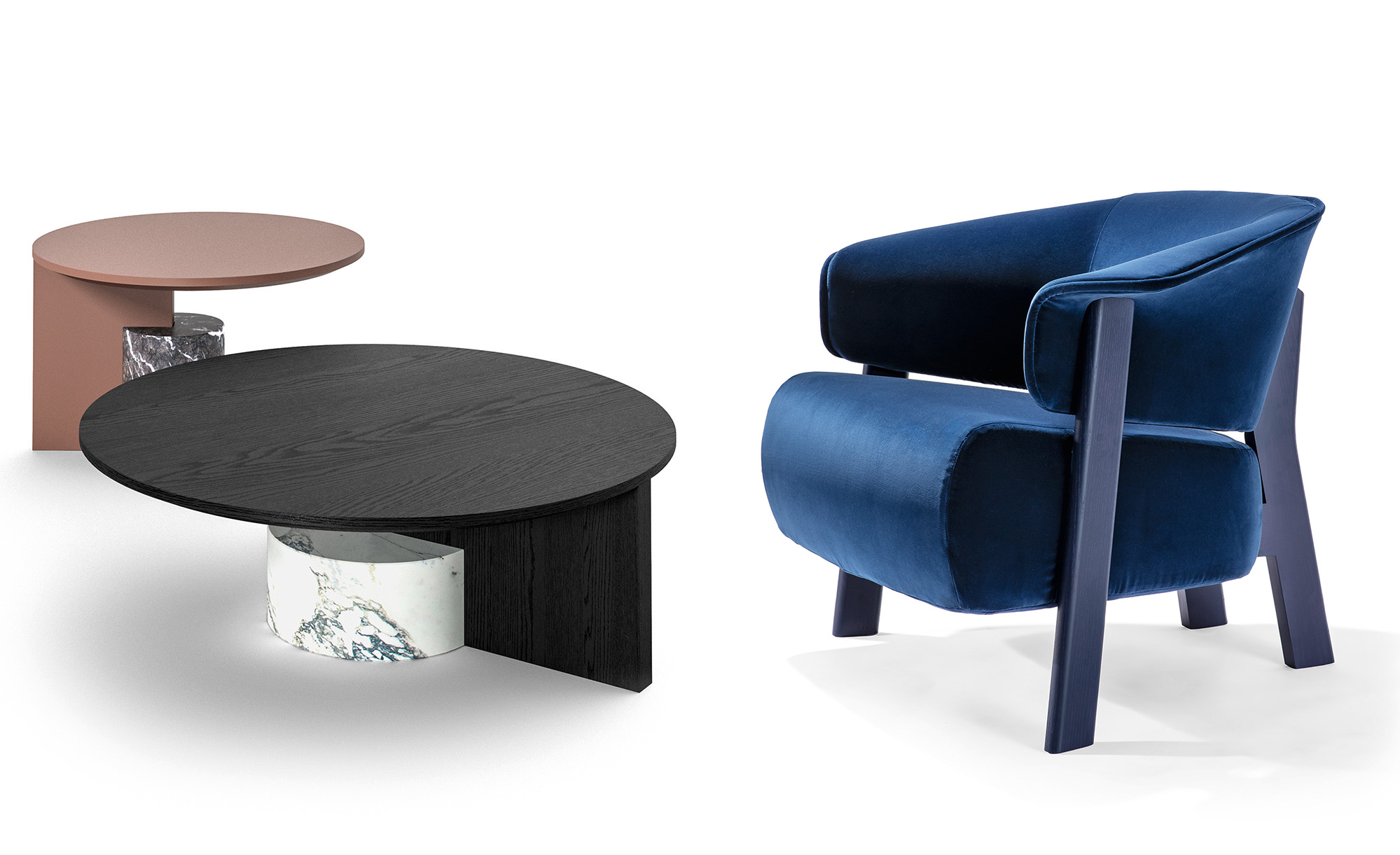
From left: The Sengu tables and the Back-wing armchair, all designed by Urquiola for Cassina. Photo: Courtesy of Cassina
You start your education studying architecture, and your practice today includes a lot of interior design and sonography and things like that. Does your ability to do both large- and small-scale work make you better at either?
For me it’s been absolutely connected, absolutely necessary. These two things are connected. Mostly the ideas that come from design many times. It’s not like I wake up in the morning and things come to mind, the creativity and the ideas, and the first concept comes from a need. I create my needs from doing architecture, to solve in that kind of way. It makes me try to say we still don’t have these kinds of things. I’m a person that if I go to visit the company as a designer, it will happen to me many times, I’m critical in relation to the way they do an exhibition or the way they have the space, then after a while if it’s a company that we are working with, we make a nice relation, because that doesn’t always happen, but if it happens, they say they do it. You do the exhibition. And that creates a lot of need for architecture.
I don’t know if that makes me better, but it’s completely interconnected. I think I like in the studio when an interior designer or an architect comes. Because not all of the studio has my point of view, attitude or way of thinking. I always make them interact a lot, and then if they approach this well then, I feel very comfortable with this type of person. Perhaps they are solving the design more because they’re young with more capacity for that thing. For me, this change of scale is helpful for living and very interesting for the process.
(SPONSOR BREAK)
Do you feel, as a designer, more responsibility today in 2021, for designing products that are environmentally sustainable?
Obviously. I think it’s not a question anymore. The good news is that isn’t not a question anymore. You don’t have to suffer for that. I have a past, as everyone. Everyone would like to be young and picking up their life now. But I think this is a human condition. I think we have that kind of shortsighted point of view about what it means to be in the world. We don’t have to get dramatic; we understand that many things are on the plate this year. We have to go on and work with the attitude that we have now. Not only as a designer, from the morning when I open the water in the tap, it’s an everyday argument. I always think we have to look at the artist, they are giving us the energy to approach this with lightness and good energy.
For example, in this moment Ólafur Elíasson, an artist I don’t have the luck to know but a person that I respect incredibly. Now at Fondation Beyeler, a place in Switzerland, with a very nice and interesting building by Renzo Piano, and the outside walls—there was a kind of little lagoon, plate of water, and he needed to ask the director if he could do it, to get the lagoon inside this museum. As you know, nature gets inside our life, in the white rooms of our museums, and put in a color which is a color of contrast. Working with biologists, a green color that you have to understand as new life. You use this kind of green color because it detects the presence of new life. Then this green color gets inside the place with all this bacteria, lichen, plants, gets into this water, with the humidity, with the humidity with all the density of life. The name is “Life,” and it gets inside the place. And then you have to understand all this has to remain in our mind. I think it’s a beautiful thing.
Today is the reopening of the second moment of an exhibition with the name “Cambio,” done by two designers, Formafantasma. They speak to a new generation and are regenerating Italia. It was an exhibition they did at the Serpentine Galleries in London over quarantine, so nobody could see it. Even me, I couldn’t even go. Now they are redoing it in a different place. Museum für Gestaltung. Cambio means change. The concept is changing. I think obviously, we have to find the energy from many sides. I think from one side, artists are very good to make us feel—I don’t say confident—but to make us feel the positivity in the energy of what can be a change.
Thank you to Patricia and her entire team at the studio in Cassina for making this happen. A special thanks to Marlene Capron from Karla Otto. The editor of this episode is Stan Hall and transcriptions are by Kara Johnson. I hope you’ve enjoyed this episode of The Grand Tourist. To keep this going, please follow me on Instagram @danrubinstein to learn more. Don’t forget to follow The Grand Tourist on Apple Podcasts or wherever you like to listen and leave us a rating or comment. Every little bit helps. Til next time!