Lucrezia Buccellati: Maintaining a Legacy of Elegance
For more than 100 years, Buccellati has been known for combining technical prowess with elegant, timely designs in jewelry, tableware, and accessories. On this episode, Dan speaks with Lucrezia Buccellati about the Italian company’s founder Mario Buccellati, growing up in the family business, tackling her very first designs, and much more.
July 8, 2026By
THE GRAND TOURIST
Photo: Courtesy Buccellati
SHOW NOTES
For more than 100 years, Buccellati has been known for combining technical prowess with elegant, timely designs in jewelry, tableware, and accessories. On this episode, Dan speaks with Lucrezia Buccellati about the Italian company’s founder Mario Buccellati, growing up in the family business, tackling her very first designs, the heritage behind every collection, Buccellati’s mastery of silversmithing and goldsmithing, plans for the future of the company, and much more.
Lucrezia Buccellati: Today, I always say it’s all about creating your identity, your unique DNA, your style. For any person that wants to start their own jewelry business or fashion business, you need to create something that is you, that is different from everybody else, because that is the essence to be successful in the future.
Dan Rubinstein: Hi, I’m Dan Rubinstein, and this is The Grand Tourist. I’ve been a design journalist for more than 20 years, and this is my personalized guided tour through the worlds of fashion, art, architecture, food, and travel, all the elements of a well-lived life. Of the great maisons of fashion, jewelry, and design today, a vanishing few are still in family control in the modern era.
But one of these houses stands strong even today, and seems to grow only stronger the closer it hues to its own family spirit and sense of eternal style. Buccellati. This legendary jewelry company began more than 100 years ago in 1919 with the opening of a boutique in the heart of Milan.
While not born in Milan himself, he was from Ancona, founder Mario Buccellati was able to pick up on the quiet elegance of Milanese society and transfer that into his designs. Designs that were directly inspired by other traditions of craft, like lace and tulle. The resulting creations were technically dazzling, but aired a quality that made them anything but trendy. 100 years later, while styles of the day may have changed, the results of these eternal techniques are still producing coverable designs. Beyond the company’s mastery of gold, it’s also known for its silversmithing that produces everything from tableware and accessories to works of art. Today, the Maison is known all over the world, in both jewelry and high jewelry, in addition to works of design.
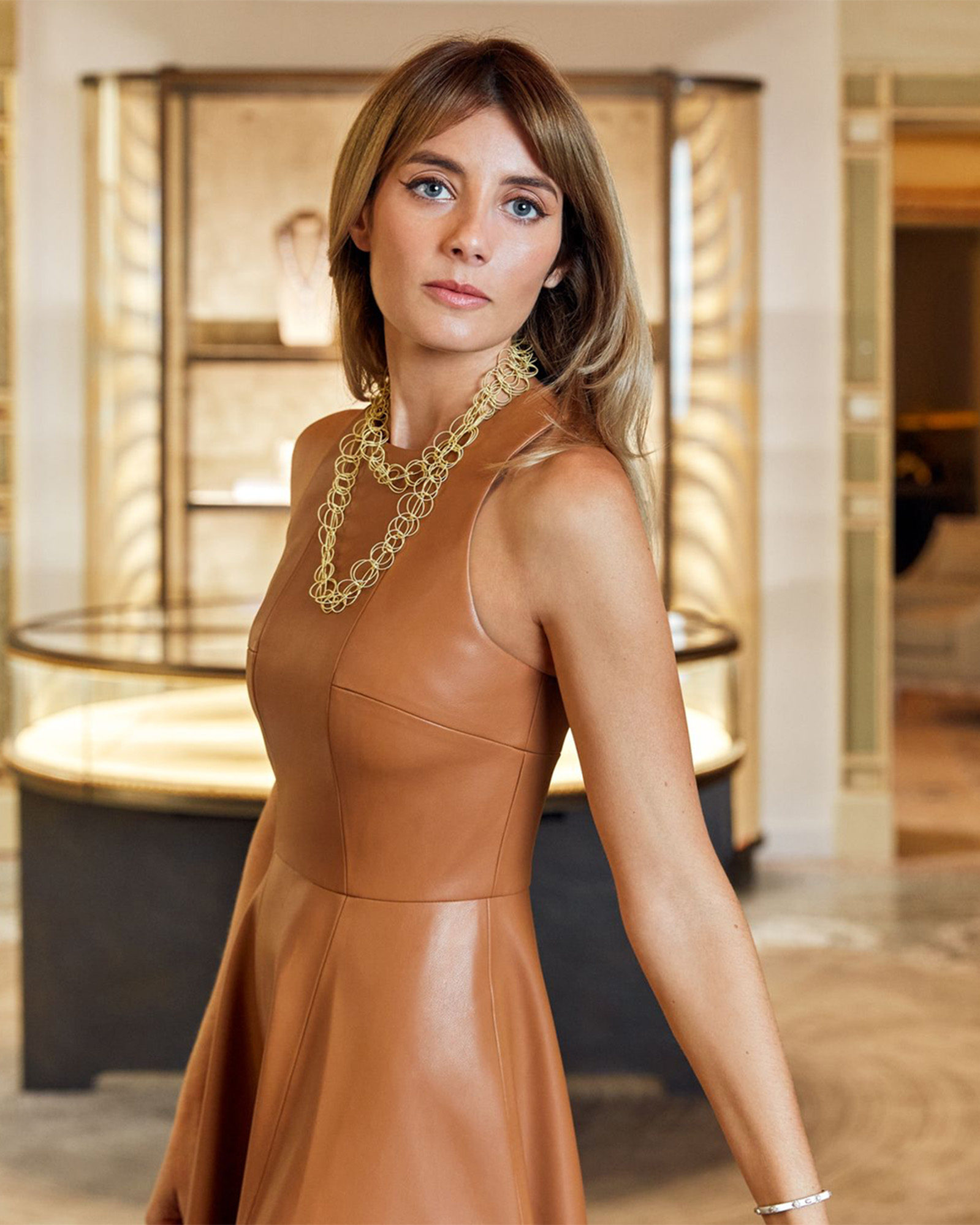
Today, my guest is Lucrezia Buccellati, Mario’s great-granddaughter. She’s the first female designer in the family and she works closely with her father Andrea, who is the creative director. She splits her time between Miami and Milan and is a fitting bridge between the past and the future.
I caught up with Lucrezia from her home in Florida to chat about growing up Buccellati, what it was like for her to tackle her first designs, the story behind some of her company’s most legendary collections, plans for the future, and more.
So, you know, thank you again for doing this. I know we’ve met in Milan a few times, and it’s so nice to get to talk to you, you know, one-on-one in this format. You spent a lot of your formative years in Milan, but I read that you were born in Miami and you’re down there now, I believe. Tell me a little bit about your childhood and what it was like growing up in the Buccellati household.
Yes, I was born in Miami. My mom is originally Cuban and she had her family here. My dad, of course, is Italian. So for the first three, four years of my life, I really spent half of the time between the US, well, especially Miami and Italy. At the same time, it was when we were expanding a lot in the US. So for my father, it was, you know, also a great opportunity to work with the US market at the time.
And then I believe when I was like four or five, entering preschool, kindergarten, we based out of Milan. Summers, we would still come back to Miami to see the family of my mom. She was very close to them. It’s nice to have, you know, the roots of this Cuban region because they were actually from Cuba and then left Cuba, based in Miami. But then I really grew up in Italy and Milan, as you know. So, yeah, so around four years old, it’s where really we were based in Milan and I grew up there. I did all my educational years in Milan until high school. After high school, I kind of like took some time to really understand what I wanted to do next. We call it a sabbatical year.
I was traveling a lot in different parts of the world, working a little bit with my mom. She’s in fashion. And also kind of designing my own jewelry. It was more accessory jewelry. I worked a little bit with India and different parts of the world and really got an experience of, you know, the jewelry world in itself and different aspects of it. But I think the real challenge it was, and the big question was, was this something that I really wanted to do? Was it my passion? Or was it something that I thought I needed to do because I was born in it?
When do you remember the first time that you really learned about the family legacy? Or as a child, was there ever a moment where you kind of remember this sort of realization? Or did someone sit you down and tell you about it as a young girl?
So for us, the Buccellati world was really part of our everyday life, right? It was very natural for us. As kids, we were part of this world. And we really saw it a lot when we were celebrating, you know, special celebrations, birthdays or holiday dinners, family gatherings. There was always, you know, this Buccellati world craftsmanship around us. It was, I believe, later on and I was thinking about it. I believe like when we had the exhibition at the Smithsonian, I was probably like 10, 11 years old. That’s where I realized what Buccellati, you know, like how important and how known and how people appreciated our craftsmanship.
Because before it was just part of our life. It was, you know, every day I had it in our, you know, tables or in our living room and this, you know, coffee tables. There’s all the little furry animals or the leaves. And I never really realized until we had the Smithsonian exhibition. And I saw all the beautiful pieces that my grandfather and my father created for that exhibition. And how the people were so mesmerized by this. You can really see how they were loving every single piece and the craftsmanship. And that’s where all of a sudden I’m like, okay, so this is something really, really special. But until then, it was really part of our life.
It’s funny because they asked me when, you know, did you really start entering this world or understanding, you know, what Buccellati was. But when we were kids, the only way to see our grandfather, because his second home was the atelier, his office. So the only way to see him was going to the atelier.
Do you remember your first visit?
I don’t know if I remember my first visit, but I remember this huge door all like in wood, all engraved. And you had to ring a little bell and then he would let the door open. And then you would enter and you would see him. He was on the right. And on his desk, there were always all different types of stones or pearls. And then him, always designing and looking at the stones. And it was beautiful to really see how he would just create something so unique from nothing, right? From a little stone. And with his vision, how he created this beautiful collection, one of a kind pieces. And it was always a story. There was always something special about it, which I think is also so important today when we create jewelry. There’s always a story, a memory, an inspiration, something that when then we, you know, reinterpreted into our creations.
Was there a family meal that was always the most elaborate? Was it like a Christmas?
Yes. So the Christmas holiday dinner was the big family gathering where everybody came over because my father and my aunt Maria Cristina, we were all in Milan. But my uncle Gino, who used to take care of all the silver, was in Bologna where we have our atelier in Bologna.
So we all would come, all the cousins. It was so fun because it was just a moment for us all to get together and enjoy each other. But as well, you know, surrounded by all these beautiful Buccellati table pieces, objects. And I remember the most exciting part was that my grandfather would always give for Christmas a present to, you know, his kids and to their significant others, a Buccellati piece. And we were always so excited to see what it was.
So it was like the moment of suspense and then opening the box. And then, I don’t know, my mom would get a pair of earrings. My aunt would get a brooch. My dad, I don’t know, a watch. So it was really a celebration, but it was always a surprise. And for us, the kids, because at the time we wanted toys, it was so exciting to see this, like the opening of the little Buccellati box. So that was a fun memory of the time.
Do you remember the first Buccellati gift that you received?
When we were born, my grandfather always made a religious object for each of his grandkids. But the piece that stayed the most with me was, I must have been in elementary school. I’m not sure how, maybe seven or eight. And I remember I found this little stone on the ground. It was probably a Swarovski. And I went to my grandfather because my school was actually very close to the office. On Wednesdays, I used to always get out of school early so my father would pick me up after lunch and bring me to the atelier and spend time there, you know, with my grandfather and him and the artisans. Like it was so exciting. I loved that. It was my favorite time of the day. And so that day, I remember I came to the office. I see my grandfather. I was like, grandfather, “I found a diamond.” And he looks at me and he was about to say, “Well, this is not a diamond.” But I said, “Can you please design me a ring?” Because it was something so special. I was so excited. And so he didn’t say anything. And he designed this cute little ring with a teddy bear. And in the belly of the teddy bear, there was like a little diamond, tiny, tiny little diamond. And it was all engraved, the teddy bear. And that was really my first piece of jewelry that for me was the most exciting. And in fact, when we decided to create a collection for a baby collection, we got inspired by this teddy bear and we created Bubu.
And so you see the teddy bears. We have silver pieces. We have a little bracelet, a little pendant. So it’s something, you know, for, you know, as a tradition to continue, you know, to our family. And it was very special to continue this legacy of this little teddy bear into this new collection that we have today.
And when it comes to your ancestor, Mario Buccellati, I mean, obviously, there are the formal stories, but can you tell me what kind of a man he was? Are there any stories from inside the family of what he was like as a person? Like if we could go back in time and visit him and have a coffee, like what would that be like? Do you know?
We’d love to go back and meet him for coffee. I feel he was really somebody special. I mean, he is somebody special. He was a visionary of his time. He was an amazing entrepreneur. But as well, he was a very down to earth person, very humble, very family oriented. I mean, you can see it when you have a family business. He had five kids and of the five kids, four of them stayed in the business and helped them grow it. You can see that there was a very strong unity, which you still see with each generation. We have a very strong unity family around the Buccellati world. He was funny. He was very much about creativity, handcraft.
For him, everything had to be, you know, perfect. And if it wasn’t perfect, it was reaching perfection, which, of course, do we ever reach perfection? I don’t know. But it was his aim. And you can see it in all the creations that he created and also the techniques. How each technique that he has used since the 1920s to today, it has evolved into becoming even better and better and better, challenging the artisans themselves to achieve what, you know, the end result was that he wanted. And he passed the same passion to all his kids, especially to Gianmaria, who was the one that kind of followed in his footsteps of the creative part.
There were a lot of incredible craftspeople and entrepreneurs and successful families from northern Italy and things like that. Do you have an idea of like in his particular part of the industry, in this particular sector, why he was so successful versus maybe other competitors? Was it about sort of what they were doing with the craftsmanship that made them so that the house sort of stood out and really thrived?
Well, I believe there are different reasons why he became so successful. First, logistically. Immediately his first shop, he opened it right next to La Scala in Milan. That was in 1919 when he opened his first store. And it was cited in that location because that’s where all the Milanese ladies would walk by going to the opera, to the grand soirees of the opera. So they would pass by and see all of a sudden this store with all this beautiful jewelry and unique designs. And I mean, that made a big part of, you know, his first steps into the society of the Milanese lady. But as well, the essence and the DNA and the style of Buccellati that he was able to create. For him, it was not so much about the stones, but it was about the gold, how to elevate the gold and make it, you know, almost texture like.
And this was really driven by his passion for Renaissance textiles like Venetian lace works, brocade silk, and unique thin embroideries. It was all this unique type of workmanship that he was like, I want to create this in the metal. So his big question was, can metal be as soft or feel as soft, airy and sensual as fabric? So that’s practically what he was able to create in the pieces of Buccellati with the techniques that we use, the lacework technique, this transparency and, you know, delicacy of the piece itself. The engraving, the rigato engraving that recreates a silk-like texture in the gold. So the ornato recreating motifs of laceworks around the stone where it really pops the stones.
So it was all this very strong passion to these textiles that created the aesthetics of the brand. And that’s what made him so successful. But today, I always say like, it’s all about creating your identity, your unique DNA, your style. For any person that wants to start their own jewelry business or fashion business, you need to create something that is you, that is different from everybody else, because that is the essence to be successful in the future.
And, you know, obviously silver is such a big part of the Buccellati legacy, especially when it comes to tabletop and things like that. And you guys have a particular expertise with that. Can you tell me a little bit about that from a design point of view? How do you feel like maybe you guys work with silver that makes you stand apart? So it’s one of those materials that it’s so versatile and can be used in so many different ways, you know, that it kind of is such a… Sometimes it’s overlooked, I feel like, or especially lately in design.
So silver has always been part of the Buccellati world since the beginning, believe it or not. We were very known at the time for very unique objects that my Mario, my great-grandfather, was designing and creating. As you can see in the Buccellati world, there’s inspiration to architecture, motifs, lacework, but as well nature.
The silver world is really inspired by nature. The beauty of nature, the imperfection of nature, and recreating that in silver pieces is the most challenging thing because it’s something that you really have to create its essence through this metal of silver. And it’s really something iconic of our brand, of our Maison. And it’s been part of it for as long as I can remember. I mean, it’s also a moment where you celebrate this art de la table united with family, friends, and it really always celebrates special moments together. But yes, so the Buccellati silver has always been something very unique and cherished throughout each generation.
My grandfather, for example, loved furry animals. For him, it was a very strong passion, this technique of the furry animals. And it was something that he really took upon himself to preserve this technique. It was actually almost getting lost because it was a very expensive technique to make and nobody was using it anymore. And a lot of these techniques that we use from the jewelry to the silver, it’s all about preservation, right? It’s about preserving them throughout each generation of artisan because if you don’t do that, they get lost and it’s very hard to learn or continue them.
As you mentioned earlier, this connection between lace and textiles and how that is so interwoven now with how you guys are known especially when it comes to jewelry, how do these two kinds of worlds collide when it comes to making pieces?
Well, as you see in all of our pieces, there’s never a like non-worked surface, right? Every surface of the jewelry or the silver is always handcrafted with one of our techniques. Really how like kind of the lacework that it’s what actually gives that lacework type or textile type of feel. As you can see, for example, in our cuff bracelets, the rigato technique that recreates that silk look, right? And it makes it so much more delicate and unique. But this workmanship that we use is important for us not only because it re-identifies our aesthetic, our DNA, our style, but also because it’s continuing a family tradition.
I believe that one of your first collections that you designed was the Blossoms. Is that true? Was that the first collection you kind of had your real hand in?
So Blossoms was the first collection I worked on. It was practically at around the same time I had moved to New York. It was very exciting because I really learned how to kind of launch a collection. Well, we designed the collection, then showcased it to our buyers and saw how our clients reacted to this new collection in silver. So it really started because me and my cousins, I have two other cousins, girls and then the others are all boys. And we always wanted to wear Buccellati pieces when we were little. And every time they always told us, “No, you guys are too young.” Like it’s too much. And finally, you know, when I was in my 19, 20s, we were like, OK, we need to have a collection that we can wear, but as well a collection that is going to be more effortless, versatile that you can travel with, not overthink, comfortable.
I mean, the whole thing about Blossoms is how comfortable it was, although it has a very strong statement. Everybody, when they would wear it, they would be like, wow, you barely feel this earring. So, you know, and the cuff, it’s very iconic of Buccellati. It was really creating something that was new. But at the same time, it could fit with all our other Buccellati pieces. One of the interesting parts of our Buccellati is that it doesn’t matter when that piece was made, but it always interconnects, right? So there’s pieces from the 50s that you can wear with pieces of today. And hopefully, you know, you can keep this goal of creating timeless pieces. And that’s the beauty of it.
As we are speaking today, we’re coming up on Milan Design Week, where all the big houses of Milan seem to take part in all the sectors. What does the word design mean to you and your family? You know, being part of this sort of greater family of sort of design versus just only jewelry or only like sort of tabletop? Like, what does that mean to you guys? Why is it so important to be a part of that week?
For us, it’s very important to be part of this because Milan Design Week represents an icon in the design industry. And it’s also a moment for us to showcase and celebrate a lot of times our silver pieces. That’s where we every year launch or present a special collection that we have in the silver. So in the past, it has been, you know, our collaboration with Venini in the spaces encasted then in our silver base. And we had the plates with collaboration with Ginori. So there’s always this collaboration of cherishing the design, the art of design with our techniques, but as well showcasing how we’ve been, you know, preserving and maintaining this high quality attention to detail of craftsmanship in the silver with these new designs.
And a lot of these designs, it’s interesting. So the design that we will present this year is inspired by a piece that my grandfather designed, Gianmaria. It was the Caviar goblet.
It was designed, I believe, in the 80s. And it was beautiful. It was this goblet with blue, well, cabochon sapphires, jade and then gold and all engraved in gold. And it was really a special piece that it was interesting at the time between the 80s, 90s, 2000. My grandfather had a very strong passion of creating this very unique pieces, you know, these goblets, these cups that were all gold and glass and precious stones. Really something more like an artist.
I mean, I would say we are artists, but really enhancing all the details in the craftsmanship that Buccellati offers in this magnificent pieces. So we’re very excited for Milan Design Week to present the Caviar Collection, where we offer so many different pieces for the table between flatware, table pieces that are inspired by this beautiful goblet that my grandfather did.
And obviously, one of the big tabletop icons is the Tahiti, which, of course, I can’t speak to you without speaking about it. It’s something that became so popular again in the past, I would say, decade or so. And it’s been so obviously widely copied, which is the best form of flattery. How did that collection begin? Tell me a little bit about that.
That collection started in the, it was designed in the 60s for an Italian industrialist that wanted it for his yacht. So it was really a custom piece at the time. And from there, it had like so much success. Everybody loved it so much that then we created a whole collection of the art of the table, where we have the flatware, we have the ice bucket, we have the every single element you can think for the table in this collection. So it’s really something special. It’s kind of like a natural, eco-sustainable collection, in a sense, because you have this bamboo. And I love the fact of blending the natural element with our silver and our craftsmanship that it’s inspired by the natural elements.
Because you’re also, I think you, it was a few years ago, right? Where you sort of came up with some new like picnic baskets and things like that.
Yes, we did some picnic baskets. So we really want to expand and cherish the moments of where people get together. And usually these moments are always around a table or, you know, a picnic and celebrating the art, you know, of hosting through our pieces. And you can really have a lot of fantasy because it’s not really like same thing for the jewelry. It’s not that because you pick one collection, you have to stick with that. You can have so much freedom because they all connect with each other, right? So you can have the Tahiti collection, but then you can have the caviar jar or the caviar ice bucket. And then you can have all our leafs that you can set up at the table or the gem jars. So you really become the artist of your own table using our Buccellati pieces.
And as you know, you’re part of this next generation of the family and, you know, you understand this U.S. market. And where do you see the Maison going in the next, you know, decade or so? Like, what is the aspirations of you and the family in terms of like where you guys are looking to take the sort of Buccellati name?
Well, Buccellati, we want to keep it as, you know, the name, it’s a recognition as is continue this tradition, this timelessness throughout the future with hopefully the next generations coming in. But it’s what we have been preserving for over a hundred years and we want to keep on preserving. Of course, we evolve, right?
So from pieces that my designs that my grandfather, great grandfather made, we also have a to get inspired from those and evolve them into a bit of a newer design or a more contemporary design, really listening to what the customer wants. But it’s really about continuing this tradition, preserving the craftsmanship, maintaining this, you know, meticulous attention to detail in every sector. And that’s the most important for us.
What’s your greatest challenge?
So my greatest challenge, and we’ve been working on it with my father in the past collection, is been a, you know, it’s been to evolve our techniques into more modern design, but not really. Almost challenging our artisans to go out of their way to find new ways of how to interpret our designs. So let’s take an example. My father and I did this collection that was called Timeless Blue, inspired by Impressionist art. Impressionist art is all about free forms and, you know, these waves, for example, the Monet waves or this nature that’s very irregular. So we took techniques that usually are so geometric, so precise, and so symmetric and made them into more irregular forms to recreate the natural movement of the wave, of the leaves or of the wings. For example, we created these earrings that were these beautiful wings and with the honeycomb technique, the lacework technique, we were able to create that, you know, likeness of them, but also that movement that it’s so, you know, unique to itself of the wings.
So it’s a challenge to kind of like help to constantly contemporize rather than saying modern maybe, but like to kind of contemporize all of these things in a way that can always do something new, right?
Yes, I think that, you know, that’s one of the challenges, but as well to keep on perfecting, you know, a little bit going back to the idea of my great-grandfather, always reach perfection or reach something new for ourself, maintaining our iconic, you know, DNA and style, that’s always the challenge to be able to create something unexpected, but that is expected using our techniques.
I mean, a lot of people talk about this sort of intersection between, you know, fashion and design and the age of media that we’re in and e-commerce. Do you feel that there’s a lot of pressure to constantly create new pieces and new collections? Like, is that cadence, that sort of tempo of creating new things, is it different than it was maybe, you know, 10 years ago or 15 years ago?
Well, definitely 10, 15, 20 years ago, it was a different time. Definitely social media gives an opportunity, I believe, to reach out a broader market, but also showcasing in different ways our silver pieces. So, for example, just seeing from my social media platform, right, one of the goals that I have and we have with the company is through my portal, showcasing different ways of how you can wear Buccellati and how you can style it, and then also telling and creating stories of what is Buccellati, the insides and outs.
This is a strong reach that we never really had accessibility to that, but as far as creating new collections, that’s not what Buccellati is about, because we have the Icona collection, for example, collections are collections that we have since 10, 15 years. What we do is a lot of times we will maybe create new pieces for that collection for add-ons. So, for example, let’s say that the customer wants a smaller earring, right? We noticed that, I don’t know, the Asian market wants a smaller pair of earrings because the ones that we have are too big, so we’ll create the same version, but smaller. We’ll kind of create modification depending on where the market and clientele is going, but the design, the aesthetic of the design stays the same. We rarely really come out with a whole new collection. Maybe every four or five years, but then we do the one-of-a-kind collection every two years. Two years is because it takes actually two to three years to create this one-of-a-kind collection that usually has about 30 to 40 pieces, and it’s such a long process, but also that’s the beauty, right? That the waiting time, like for us as the creatives and part of the team is always seeing all these pieces being made, and we can’t wait to be seeing the whole collection finished, and it’s like the most exciting thing. But, yes, so Buccellati is really not about following trends. It’s about we have our own trend. We look at what happens throughout the different fashion worlds and the different markets, but we keep our timelessness, let’s say, which is the essence of our Maison. So, yes, that’s really who we are and what we are about.
And how has that expansion into Asia been for you? They’ve been more receptive over time to this very Italian kind of strong identity?
The expansion in Asia has been very successful. It’s been really something we focused in the past, let’s say, 10 years, and it has grown a lot. The Asian market really loves the craftsmanship, the story behind, I mean, they love Italian made. So it’s something really that has grown and it’s been super successful. They like a lot customization, I have to say. But also there, what I noticed is that they start kind of their introduction to the brand with like smaller Icona collections pieces, and then from there, they really fall in love with this story and who we are and then become wanting more like one-of-a-kind pieces or special orders just for them.
They have a very strong appreciation also for very beautiful stones, so colorful stones. So that’s fun because they always have different ideas and we can create different designs specific for their stones. But yeah, the Asian market has been unbelievable for us. We’ve been growing a lot also in the Middle East. And I mean, U.S. has been one of our also greatest markets since a long time, since the 1950s. That’s when my great-grandfather Mario with his wife decided to come to the U.S. and see if Buccellati was something that could have a lot of success and how was the market for Buccellati. And he traveled different major cities in the U.S., D.C., New York, Palm Beach. Although he didn’t speak a word of English, so I don’t know how he did it. Because at the time, we didn’t have the Google translator or something, but he immediately saw the huge potential and the reaction of the customers that saw his pieces and saw the designs. And very soon after, he opened the first store in New York and from there, Palm Beach. And then it expanded throughout family tradition.
And how many people are working on the atelier side of Buccellati today?
Of the family or in general?
In general, like the whole?
Oh, I don’t know. I don’t know exactly the thing, because we’ve been really expanding in bringing up new artisans, because one of our biggest challenges actually is being able to create the pieces, the demand that we have. But our pieces take so long to make. So one of the things we have been really working in the past five years is developing our new artisans, young artisans, following our already strong artisans that know all our craftsmanships and developing them into mastering our techniques. And so on to building up for the future, for a stronger demand to be able to support.
And what’s the biggest challenge about finding these new craftsmanship is just sort of like bringing them up and training them enough to kind of get them to be able to create these things?
It’s interesting because there was a time a few years ago, like I would say like 10 years ago, that a lot of the kids of the artisans, of our artisans, did not want to do the artisan work, right? They saw it almost like it was not important enough. They wanted to be like lawyers, doctors, or I don’t know, finance, whatever. Like they wanted to go in a different sector. They didn’t see, I think, the value that it has. And all of a sudden in the past few years, there’s such a strong coming back, you know, of Italian artisans and craftsmanship. So there’s a lot of younger generation that are really coming and learning different techniques in the jewelry, but as much also in the different sectors of different fashion brands and stuff. Like there’s really coming back to learning these craftsmanship that, I mean, they only can be made by hand. So it’s something that…
What do you attribute that to? Why do you think that’s happening? Which is great news. Why do you think that’s happening?
I think Italy, but I’m sure France as well, we’ve been really pushing into cherishing and celebrating this craftsmanship, right? We see it also from the brands themselves. And you see it also, I find, in social media, in the platforms that you see where they’re showcasing even more how it’s made, you know, the savoir faire.
And that is so essential because especially today, there’s so much, right? We are exposed as a client, right? You’re exposed to so much, so many things, so many brands, almost overwhelming. And sometimes coming back to just seeing the basics of how it’s actually made. It all of a sudden also gives confidence, right? To the customer.
It’s like, okay, it’s still made by hand. It’s true to who we are. And the same has been a little bit for these artisans that they all of a sudden see how important and relevant they are. That without them, this will not be possible. So I think there’s been this very strong push from Italy to, you know, support and enhance this throughout this new generation.
And if I had to ask you just real simply, just to rewind a little bit, if I had to ask you, what is Buccellati? If I met you at a party and I had no idea what Buccellati is, how would you answer?
Buccellati is refined, intricate, and timeless. And it’s recognizable miles away, as they say, by our iconic style.
Thank you to Lucrezia Buccellati and to everyone at the Maison and DADA Goldberg for making this episode happen. The editor of The Grand Tourist is Stan Hall. Don’t forget to sign up for our newsletter, The Grand Tourist Curator at thegrandtourist.net. And follow me on Instagram @danrubinstein. And follow The Grand Tourist on Apple Podcasts, Spotify, or wherever you like to listen and leave us a rating or comment. Every little bit helps. Til next time!