Louis Venturelli Captures Love and Memory in Shades of Blue
For the New York artist’s first solo show on the West Coast, Venturelli presents a series of paintings and photographs. Blue is the common thread—the disparate mediums explore how color can hold and evoke cherished memories.
November 20, 2026By
HELENA MADDEN
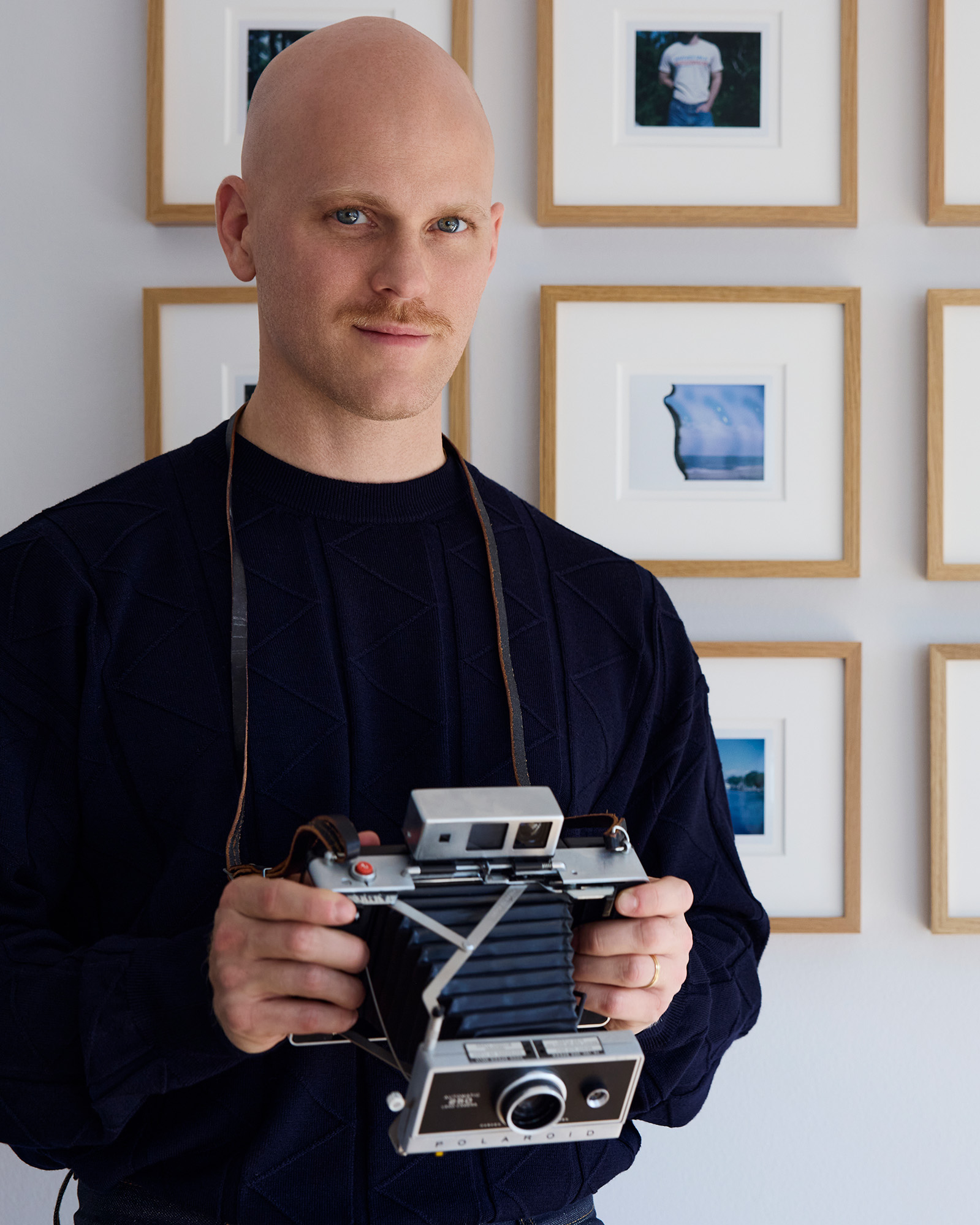
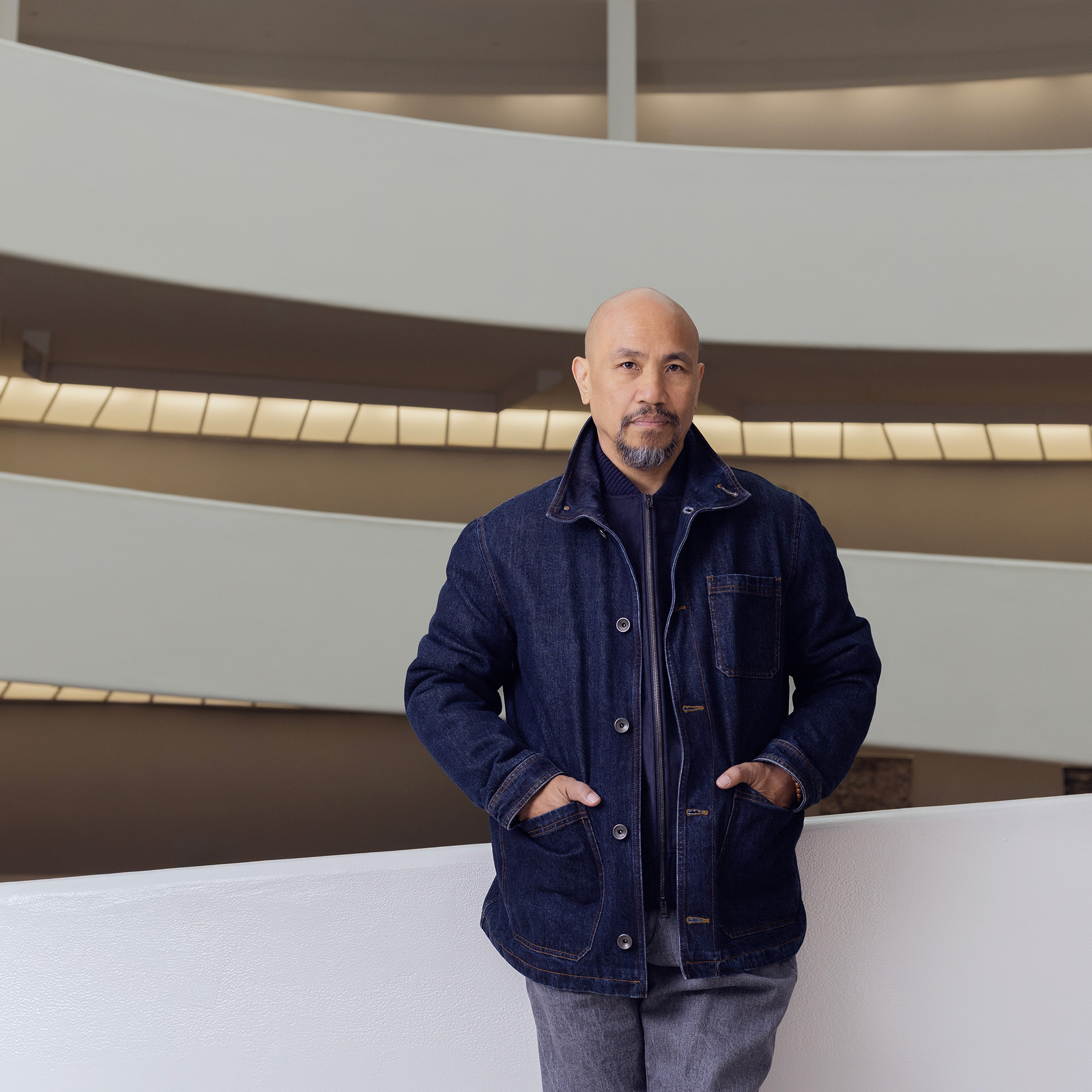
Artist Louis Venturelli with his Polaroid camera from the 1960s. Photo: David Zimmerman
Color plays a central role in Louis Venturelli’s abstract paintings, which distill museums and cultural institutions into vibrant geometric shapes. The 37-year-old, New York-based artist carefully selects shades based on his recollection—perhaps it’s a tile on a gallery floor, or the way sunlight spills into a room. He layers these disparate hues into angular forms, capturing the feeling of a place through minimalist composition. Amidst this insightful series, the color blue holds particular meaning: Venturelli associates it with friendship and optimism. The hue is the common thread within “Love Is the Color Blue,” the artist’s first solo exhibition on the West Coast, now on view at Cannery Village Gallery in Newport Beach.
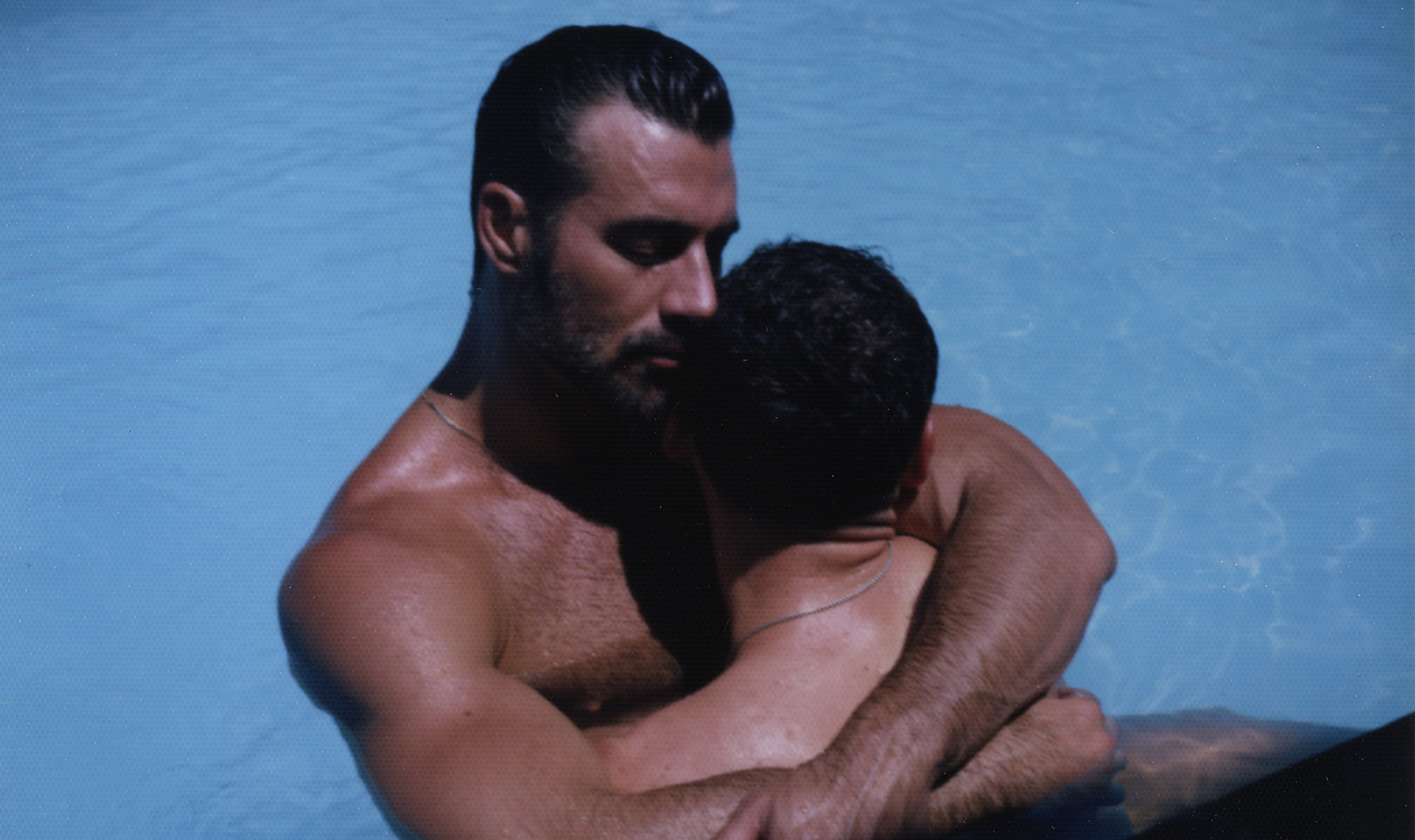
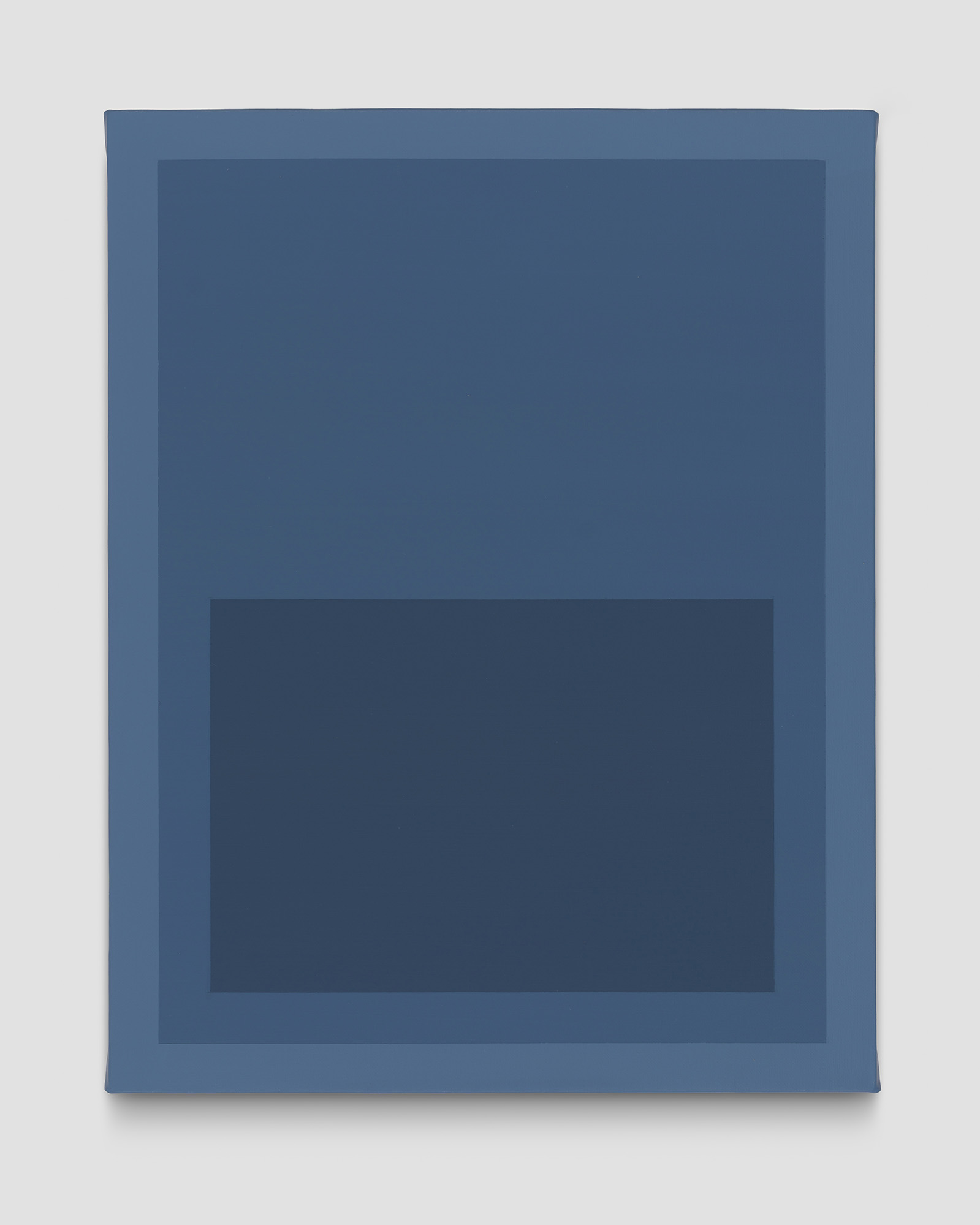
For the show, Venturelli presents paintings inspired by the California sky’s reflection against the glass facade of the Laguna Art Museum. These artworks are in direct dialogue with 16 Polaroids that Venturelli took of himself and his friends at Fire Island Pines using a camera from the 1960s. The legendary gay vacation spot holds special significance for Venturelli, even becoming a spiritual home for the artist; the distinctly analog images capture the many intimate moments within the island’s queer community.
The color blue takes on a different characteristic within each of these mediums. The museum paintings recall a distant moment; the photos capture that moment as it’s happening, and freeze it in time. Blue is part of that story, conjuring memories through Venturelli’s discerning brush and lens.
The Embrace (2024), one of the Polaroids that Venturelli captured on Fire Island.
I read that you grew up in New York. When did you take an interest in art?
I grew up in Brooklyn and Staten Island in the 90s and early 2000s. So I had one foot firmly planted in the non-tech era, and then one foot in its beginnings. I loved to draw and paint when I was younger—mostly drawings of the city skyline. I remember sketching rows of windows for each of the buildings. I think that’s why I’m drawn to cubism in my work. We’re just surrounded by so much of it in the city.
So I studied art from grades six through eight, which is a bit unconventional, but in New York public school you’re asked to rank majors, and then you have that class for three years. I picked art. I think that was the gay young queer in me… being called to that when all of my friends were studying science and computers. But I had one teacher who made a huge impact on me; 20 years after graduating middle school, she showed up to one of my shows in Chelsea.
The only thing was, back then, I didn’t realize that you could make a career out of art. So I wound up studying politics and philosophy in college, and I did my master’s in education policy. Which is all interesting, but I learned quickly that it wasn’t my highest calling. I started picking up painting again when I was 27 or 28. So I’m self-taught, generally speaking. I didn’t do a BFA or MFA. I was making art to express my creative side. And having grown up here, I just felt like I was taking in so much culture, and I wasn’t giving it back—I mean, outside of nightlife and having a good time, which is perfectly fine and cool.
Then I went on a trip to Fire Island when I was 29. It was my first time visiting the community there and seeing all of these artists around me: Broadway dancers, writers, musicians, and painters. I met Doron Langberg on the beach, and he said he was a painter… I didn’t know you could make a career out of that. Now his paintings are in the contemporary wing of the Met.
So I thought, if other people can do it, why can’t I? There’s also this thing called a Saturn return, which happens at that age. You just care less about what other people think, and you realize that you have one life to live, and if you’re not doing what makes you happy, then you’re wasting your years. With that confidence, I started sharing my work on social media. I didn’t have a massive following at the time, but people started buying and collecting.
You mentioned studying philosophy before pursuing art. Did any of that coursework shape your career as an artist?
Yes, definitely. I think it’s an infinite sense of curiosity. Curiosity has played a huge role in helping me see my potential as a person and as an artist—and in others. That’s a message I always share with everybody. When I speak with young artists, I always tell them that their potential is limitless.
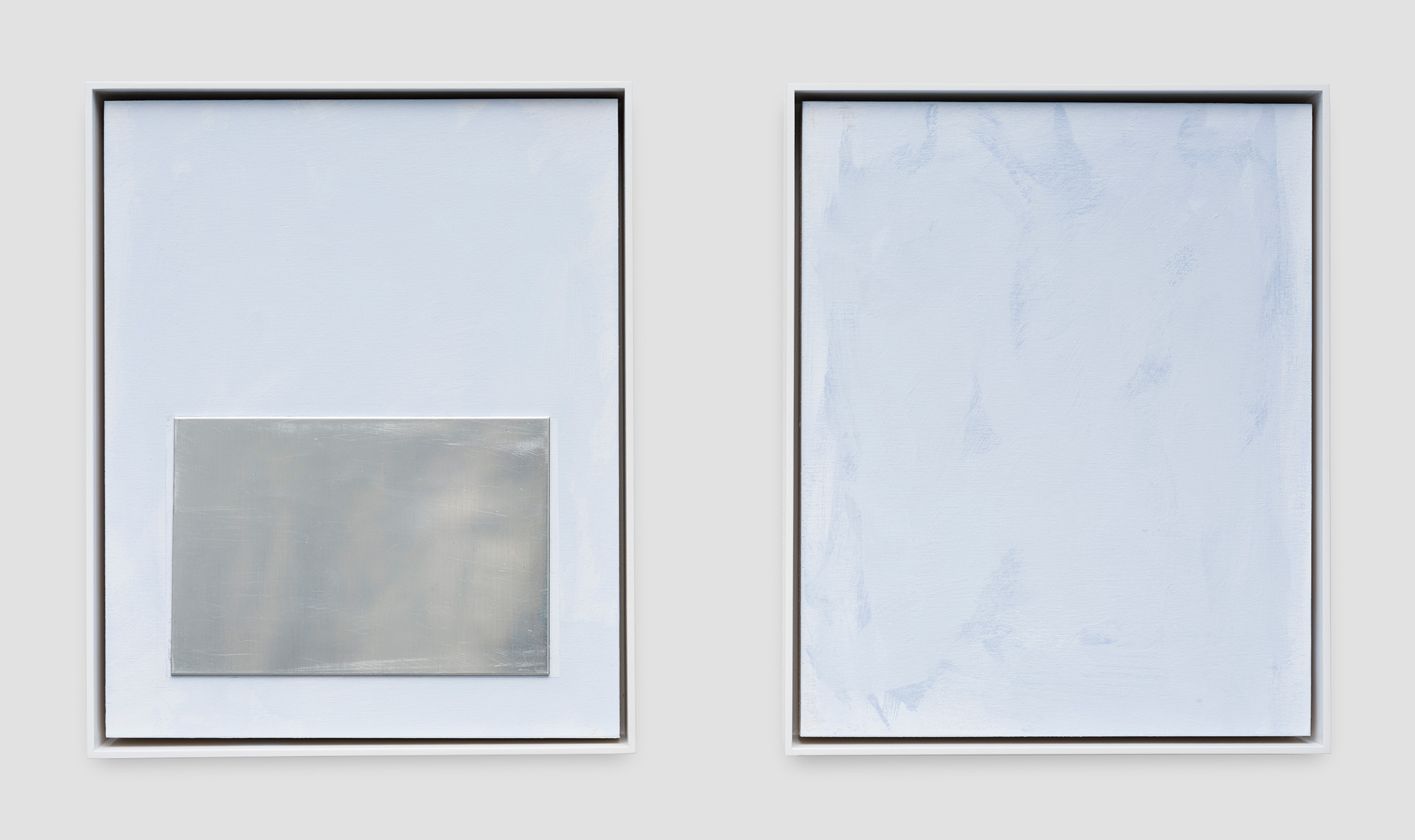
Laguna Art Museum No. 4 (2026), part of a series of six that were inspired by the museum.
Tell me more about Fire Island and how it shaped you and your practice?
I knew I was gay when I was a teenager, but I struggled coming out. Not to the extent that some people do, but I remember how hard it was for me to make the plan to go have lunch with a friend or a family member, and then by the last bite I needed to tell them: “Hey, I’m gay.”
It was a matter of overcoming and acceptance. And I think being gay has defined my life in a very beautiful way. When I went to Fire Island for the first time, I’d been out for 10 or 11 years, but it was a magical experience because of the concentration of the queer community. In New York, we get to see different people from all different backgrounds, but it was there that I felt a greater sense of community and freedom. Prior to that, I only had straight male or female bosses; I never really had a strong gay role model.
But it was the nightlife, it was the art in all the houses, it was the architecture out there. It was nature, it was freedom, it was sex, it was drugs. It was everything for me. I opened my mind in many ways through Fire Island. It was this ultimate sense of being. I was a little buttoned up in my 20s. I was the student body president at my university, and I had a good career, and I probably could’ve had a happy, successful life, but it was unrealized.
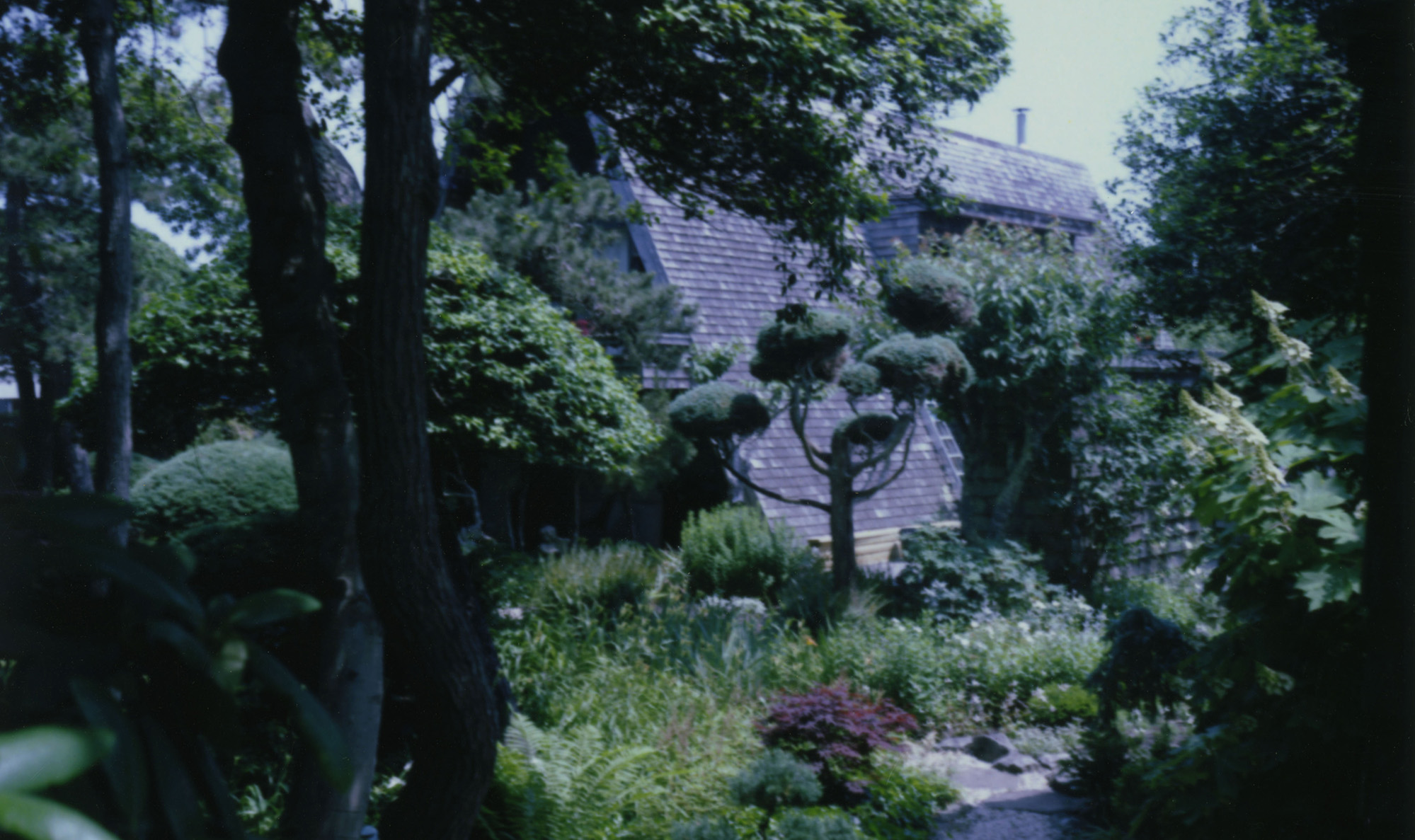
A-Frame on Midway, 2025.
I want to talk about your show, “Love Is the Color Blue.” What does the color blue mean to you?
I think there’s just some inherent things about the color blue that people love. I don’t know if it’s causal or reactionary, but when we wake up in the morning and we see a blue sky, there’s a feeling of happiness. With that comes optimism and this sense of conquering life.
Where does the title come from?
It’s because of the relationship I have with Nicholas Pardon, one of my earliest collectors, and the founder of Cannery Village Gallery. He has 15 pieces of my art, and a few that are blue—one painting is inspired by Yves Klein. We share a fondness for the color blue. So when he called me and invited me to do my first solo show on the West Coast, we just thought it was natural to focus on works that are blue. We didn’t know we were going to include my Polaroids at the time, but we thought it was the perfect pairing with the paintings.
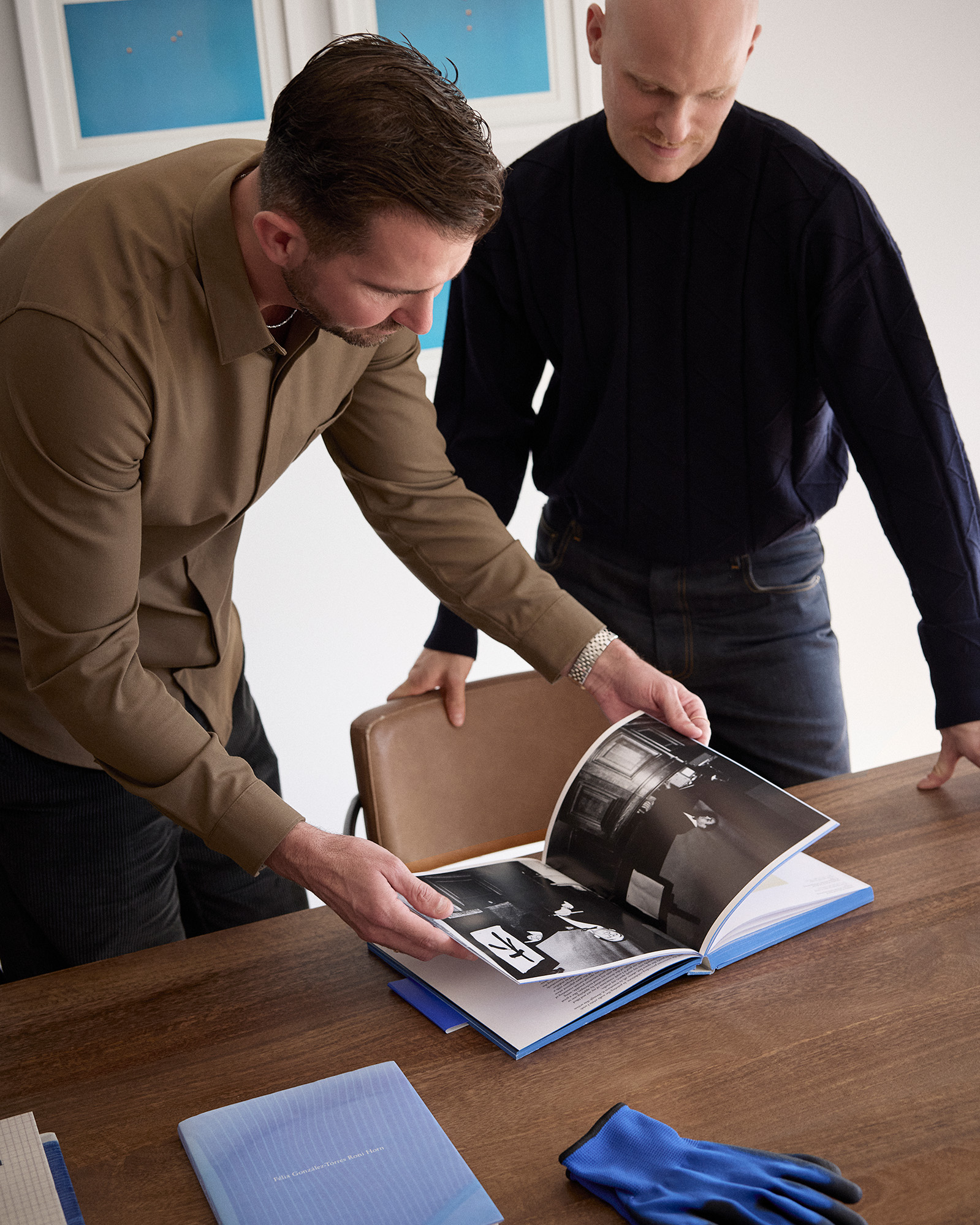
Venturelli with Nicholas Pardon, founder of Cannery Village Gallery. Photo: David Zimmerman
How do those two mediums speak to each other in the show?
The paintings represent an observation that I’ve had. So my Museum series is inspired by my visiting museums around the world. It comes from a memory—it could be of the color of the architecture, or of a room within the museum. I take those moments, and I distill them into a color that’s reflective of that time.
Photographs, on the other hand, are actual representations of where I was. I think of them as very special, because in life we only move forward. Being able to capture the world around us tells a story about the people who come into our lives and the places we’ve been, and what it’s like for humanity in that given moment.
Blue is the common thread throughout because of how much it permeates Fire Island’s summer sky. The paintings were inspired by the Laguna Art Museum. There are windows on the building’s facade, and the paintings represent how the sky reflects off of the architecture during different times of day. There’s also a piece that’s an homage to Agnes Martin. It’s a triptych, and it plays on her perception of innocent love within friendship. She’s one of my favorite painters.
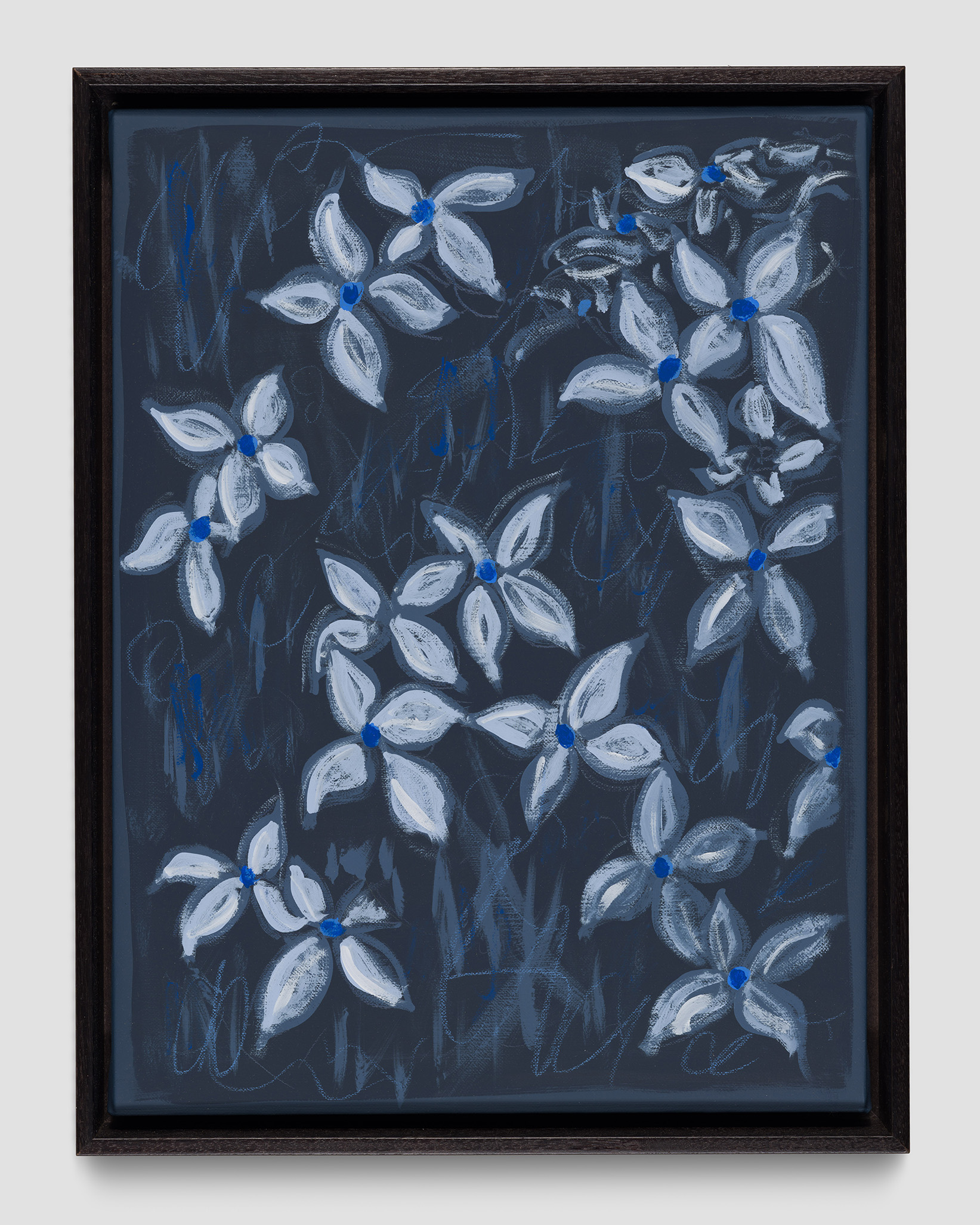
Dogwoods in Blue, 2025.
How did your Museum series begin? What about these institutions inspired you?
When I decided I wanted to be an artist, I knew I wanted to be intentional. I wanted to create a body of work that represented something really important and meaningful to me, but that could also resonate with other people.
The museum series was born because I traveled a lot in my twenties while working internationally with the Nobel Peace Prize. So I got to go to all these amazing places around the world, like Cape Town, Rome, Warsaw, Paris, and Hiroshima. Everywhere I went, I visited museums. I think they’re very important institutions that carry some of humanity’s greatest achievements, whether it’s an artifact, poetry, or a song. It was my love for architecture and for these spaces that led me to building this series. Now I have more than 500 paintings in it, and they represent museums around the world.
Friendship, 2026.
Tell me more about the Polaroids that you took on Fire Island. What do these pieces represent for you?
They were taken over the course of four summers. They’re singular, one-of-a-kind, original Polaroids that were taken on my 1960s Polaroid Land Camera. So imagine me in a Speedo on the beach with this giant camera that has an accordion. What’s interesting about the film—and why I started shooting with it—is that it’s no longer in production. It’s not a pack of Polaroid film that you can buy at a pharmacy or online somewhere. It’s all sold secondhand, and it’s not guaranteed to work. But it’s fun for me to hunt down the film wherever it exists.
What I really appreciate about the Polaroid is that it harkens back to a different generation, one that I think we all yearn to experience, during the days of Studio 54 and disco. Something that really fascinates me is the secret lives of gay men throughout that generation, which we now live very openly. So I’m taking the film that was used to capture their lives back then, and using it to capture a new generation of queer people. We’re doing a lot of the same things and practicing the same rituals that our ancestors have, like dancing, going to tea, or having drinks and catching up with friends. The series has about 115 images in it, and we’re debuting 16 of them at the show.
It sounds like the process of taking the photo is an important part of the narrative for you. It’s laborious, and very intentional.
Yes, and it builds off of my book that I published two years ago called In the Pines. It consists of a series of images that I took on my iPhone. So the photos were super, super candid. I didn’t know I would be making a book when I was taking them, so of course I got all the permissions I needed—but that really captured my first four seasons in the Pines. I came to Polaroid after that book was published. I started snapping more art-forward, intentional imagery. It’s hard. It’s way harder to take candid images with a Polaroid, because you have to use the focus, and if somebody is moving then the photos will be unique, let’s say. So it’s going from digital age photography to analog.
I definitely have intentions of presenting the Polaroids in a second book. I’m toying with the title “Quarter Share,” which is a vernacular term for a lot of vacation destinations. People will rent a spot as a group of friends, and they’ll do a quarter share where they go for one week per month from May to September. It’s the same cast of characters every month, and they have the same rooms. That becomes their summer—going to Fire Island for five weeks.