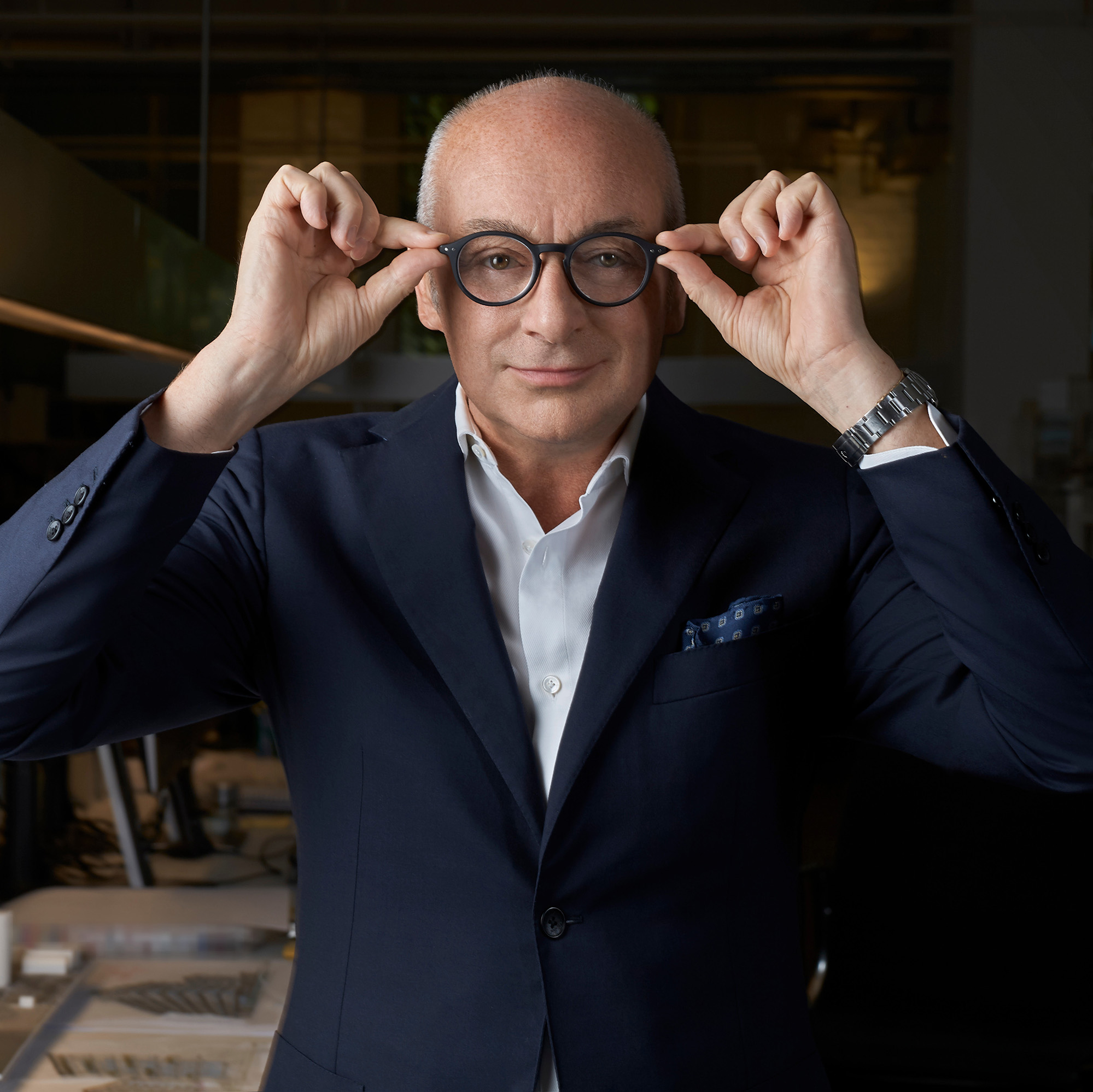
Patrick Rosal: “Have a Relationship With Your Fear”
Rosal is the fifth Poet-in-Residence at the Guggenheim New York, and one of the leading voices in American poetry today. We spoke with him about his project for the museum, his advice for young poets, and more.
November 18, 2026By
THE GRAND TOURIST
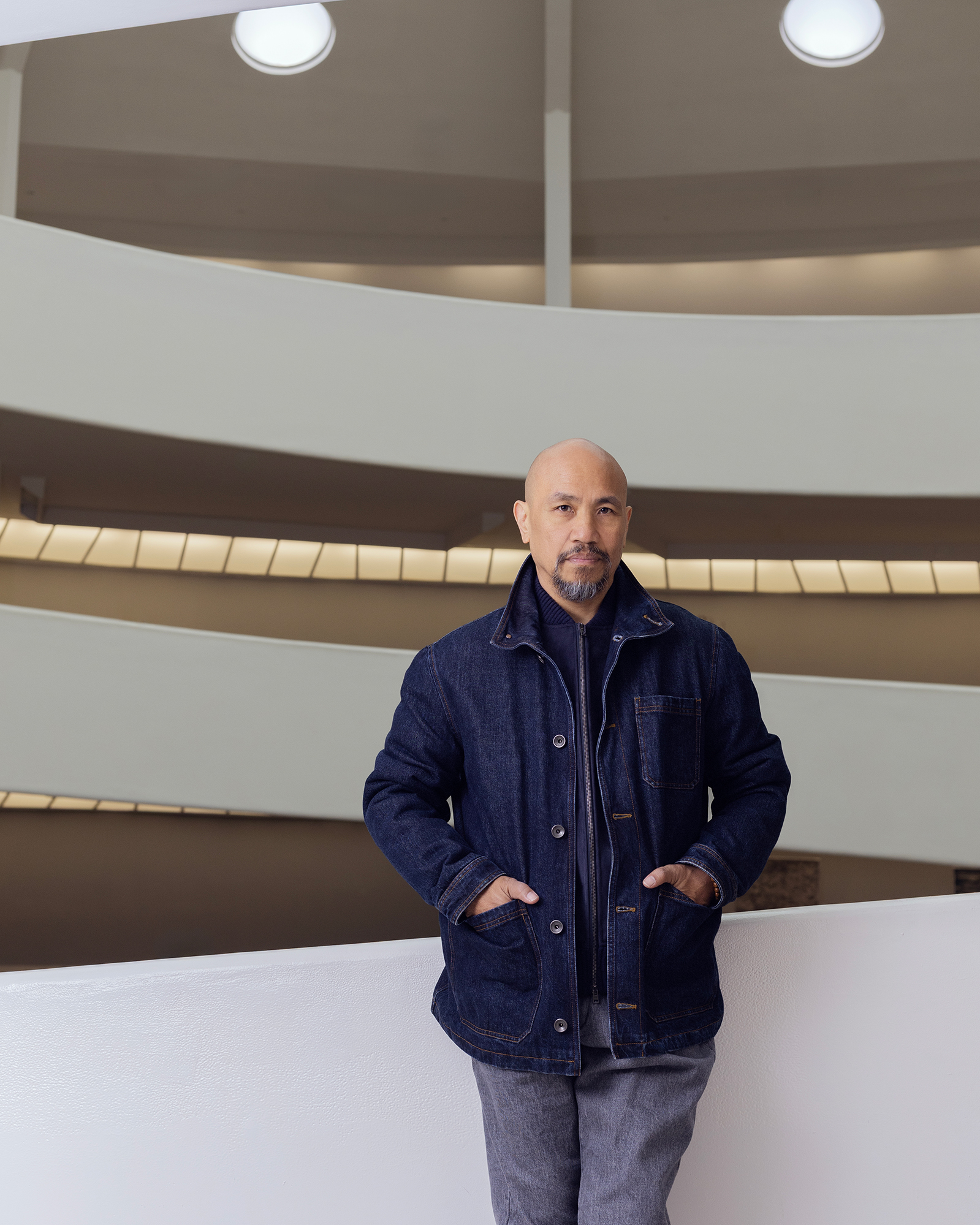
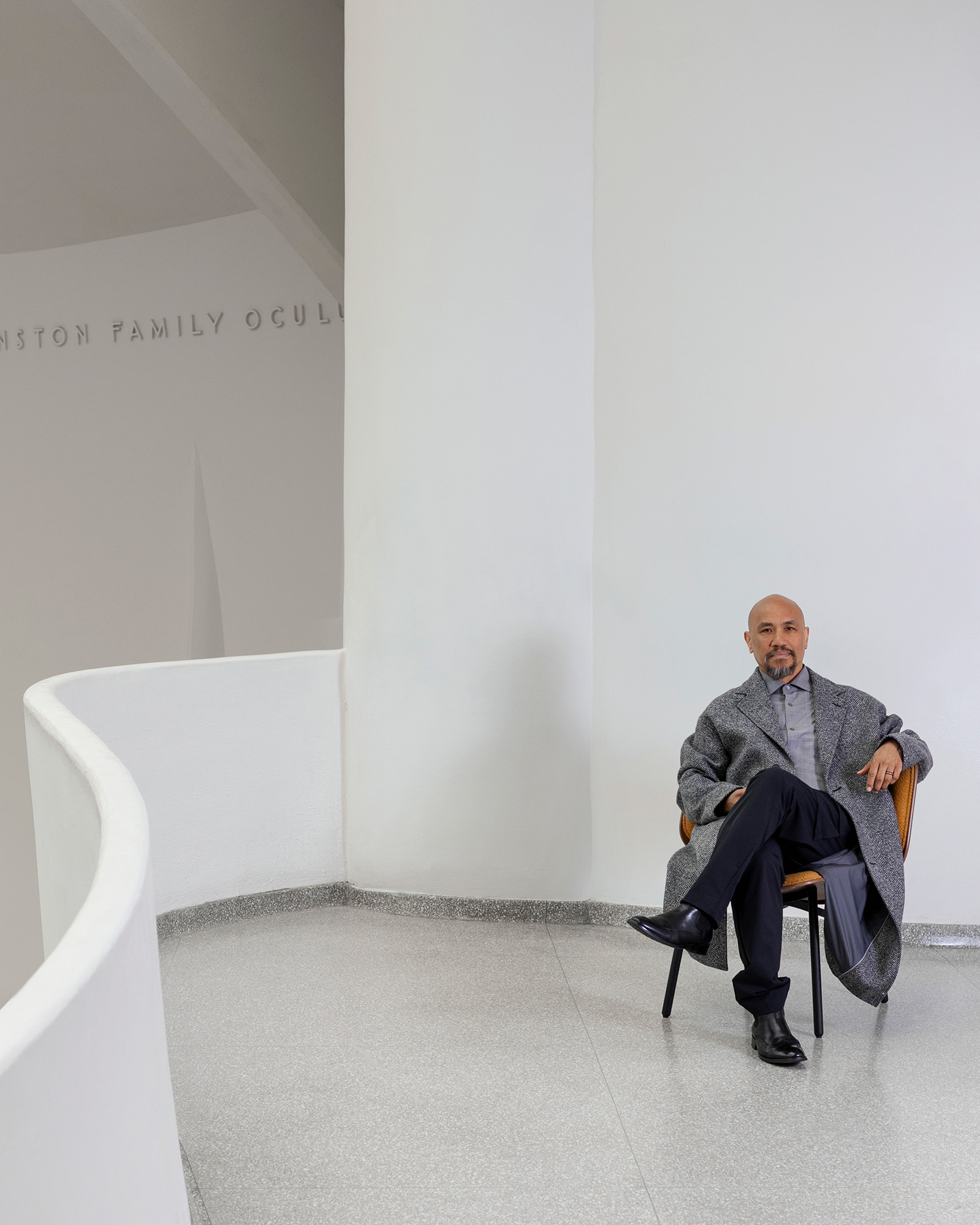
Guggenheim New York’s 2026 Poet-In-Residence, Patrick Rosal. Faux shearling jacket, denim overshirt, and denim pants, Herno; herno.com. Photo: David Sierra
SHOW NOTES
Patrick Rosal is a leading American voice in the art of poetry. He has published numerous books, received a fellowship from the National Endowment for the Arts, and this year has been named the fifth Poet-in-Residence at the Guggenheim New York, an annual program made possible by Van Cleef & Arpels that places poetry within the context of a world-class museum. On this episode, the New Jersey native talks with Dan about his Guggenheim project, “The Water Listeners,” the fascinating story of how his parents met, and his advice for young poets.
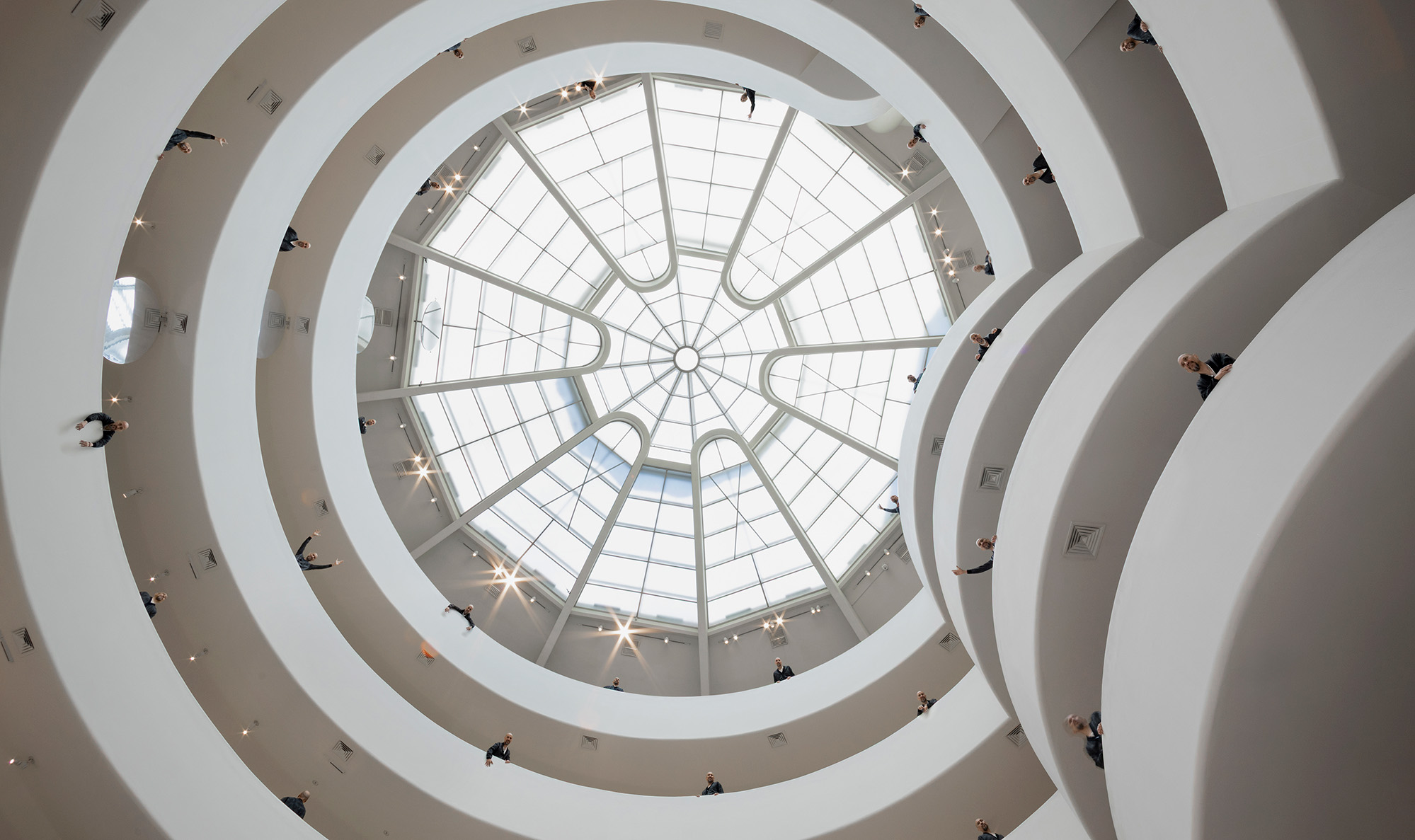
With so much of the art and design world being obsessed with the idea of collaboration, it’s somewhat of a mystery as to why one art form is routinely overlooked by so many of us: poetry. That might finally start to change after the programs generated by Patrick Rosal, the 2026 Poet-in-Residence at the Guggenheim New York, are complete. Supported by Van Cleef & Arpels, the annual award, which started in 2021, aims to explore the possibilities of the form in the context of a world-class museum.
Rosal, a New Jersey native, by most accounts had a typical first-generation American upbringing: conservative parents, a somewhat rebellious youth, followed by a search for meaning and creative satisfaction. After finding his way to poetry as the right outlet for him, which we explored in our interview, he grew a career that has won him a Fulbright, a grant from the National Endowment for the Arts, and other awards. Today, he’s a distinguished professor at Rutgers University.
His project with the museum is titled “The Water Listeners,” which will spotlight the eponymous element’s importance as an interconnective tissue for so many aspects of life and culture. It will include readings, educational programs, and other interventions. I spoke with Rosal about his parents’ unique story of how they met and sparked a family, how the music scene of the 80s and 90s inspired him to hone his poetic abilities, his advice to budding young poets everywhere, and much more.
Your parents immigrated from the Philippines and you were born and raised in NewJersey. What brought them here to the US?
That’s right. Born and raised. My mom came in 1958. I’m still not sure, actually, how she got into the country, because Filipinos were restricted from entering the United States after the Tydings–McDuffie Act in the 1930s, all the way until 1965. I think that the quota was as little as 25. There was a crack for her to get here. She emigrated to Chicago, was a dietician, and already had her degree. My dad came as a Catholic priest in 1962 to Chicago. My mom was somehow affiliated with the University of Chicago—they had a global house that invited people from all around the world. This is a period when the US was trying to invite folks in from the rest of the world. And she was a part of that, I guess.
So anyway, my dad happens to be in Chicago, which is a whole story in itself. He got abandoned by the priests that he traveled here with. He was supposed to go back to the Philippines. He ended up on the south side of Chicago and was a priest in several parishes in the city. Through the small network of Filipino healthcare workers who he was a cleric for, he met my mom at a wedding. She told a friend, “I’m going to get that man!”
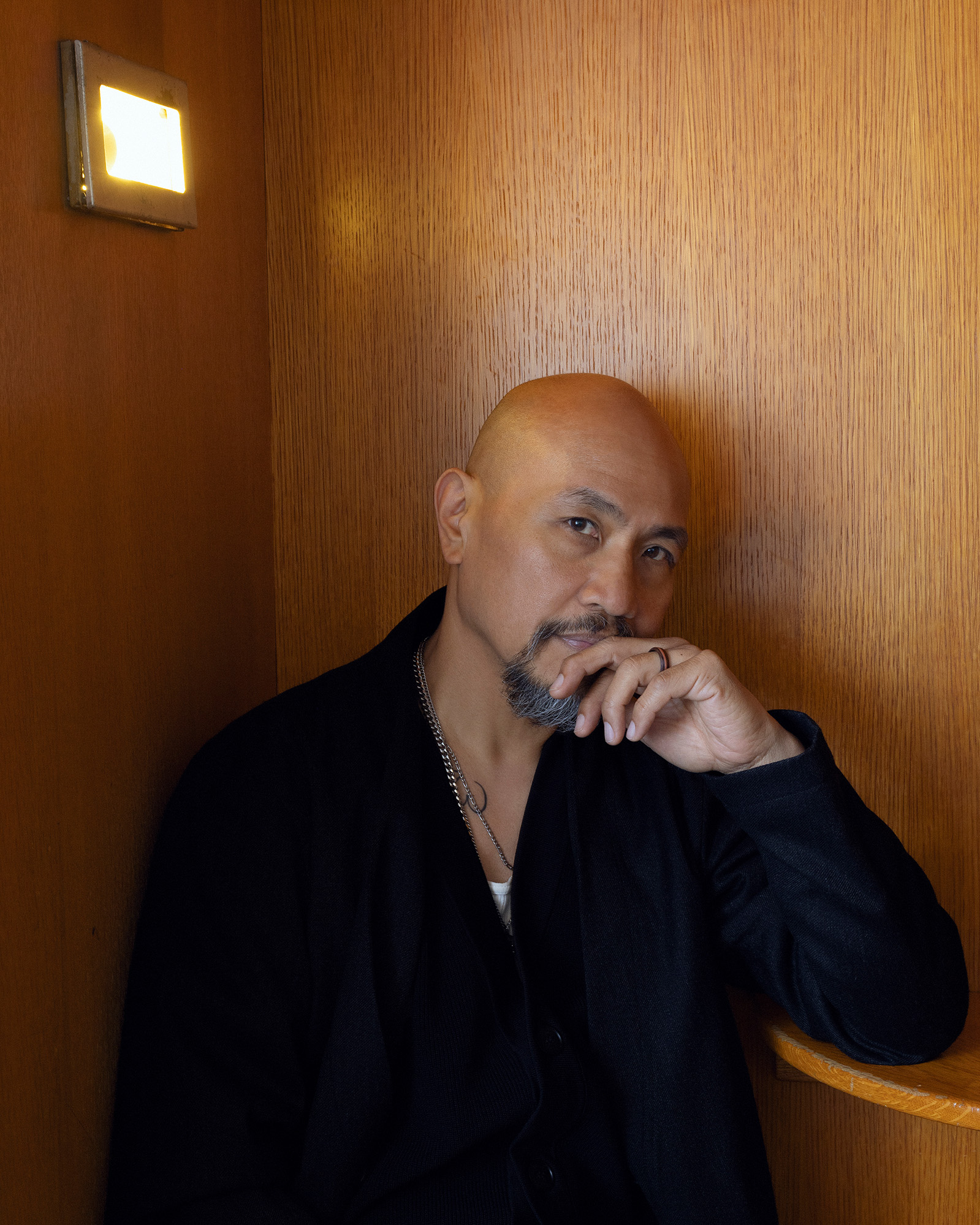
Merino wool cardigan and wool blazer, Herno. Photo: David Sierra
Wait, was he still a priest at the time?
He’s a Catholic priest. They had this affair. It’s a whole thing that I’m writing about. My mom got pregnant with my older brother and left for Canada to give birth to him. They continued the relationship. She got pregnant again. That’s when he finally left the priesthood, after she got pregnant with me. He stayed in Chicago while she was in Canada, but they all reunited in Brooklyn, and then eventually got to New Jersey.
Wow. What a story. Your mom must be quite the woman to get that to happen. Was your dad obviously very religious? What was your home life like from that perspective?
You know, my dad wasn’t just a Catholic priest. He had a PhD in theology. He was a theologian for the Catholic Church, which means he thinks through the ideas and canon law. Despite all of his own internal turmoil, having broken his vows and being an intellectual and spiritual figure for the church, he never abandoned his faith. And it was super intense. We were immersed in it. We had 12 years of Catholic education. I had my own first communion in our own living room, and we had bishops and monsignors visiting us from the Philippines and elsewhere. And so deep in the sacraments, deep in prayer. My dad’s scholarly books were all around. Summa Theologiae was on the shelves. He still talked a lot about religion and theology. My mom was a devout Catholic also, neither of them really turned their back on the church. We got soaked into the rituals and the liturgy, and in some ways, the community of the Catholic Church—although intuitively as a child, I knew that my parents were kinds of outsiders by virtue of how they ended up together. And that shame that they carried around forever, pretty much, was an energy that my brothers and I really had to live with, something that I really processed as an adult and through my own art.
Today in 2026, do you consider yourself aCatholic?
My mother-in-law’s going to listen to this. You’re putting me on the spot.
You’re on the record.
Listen, once a Catholic, always a Catholic. I’ll just put it that way. I haven’t been to church regularly in a long time. I am a deep student of scripture, of the liturgies of Catholicism, and the ways that all the different cultures have syncretized the various iconographies and rituals of the Catholic Church. So, I’m interested in Catholicism and the simultaneities of Catholicism.
But you don’t go to Mass. And that’s what Igot out of that.
Mom, I’m going.
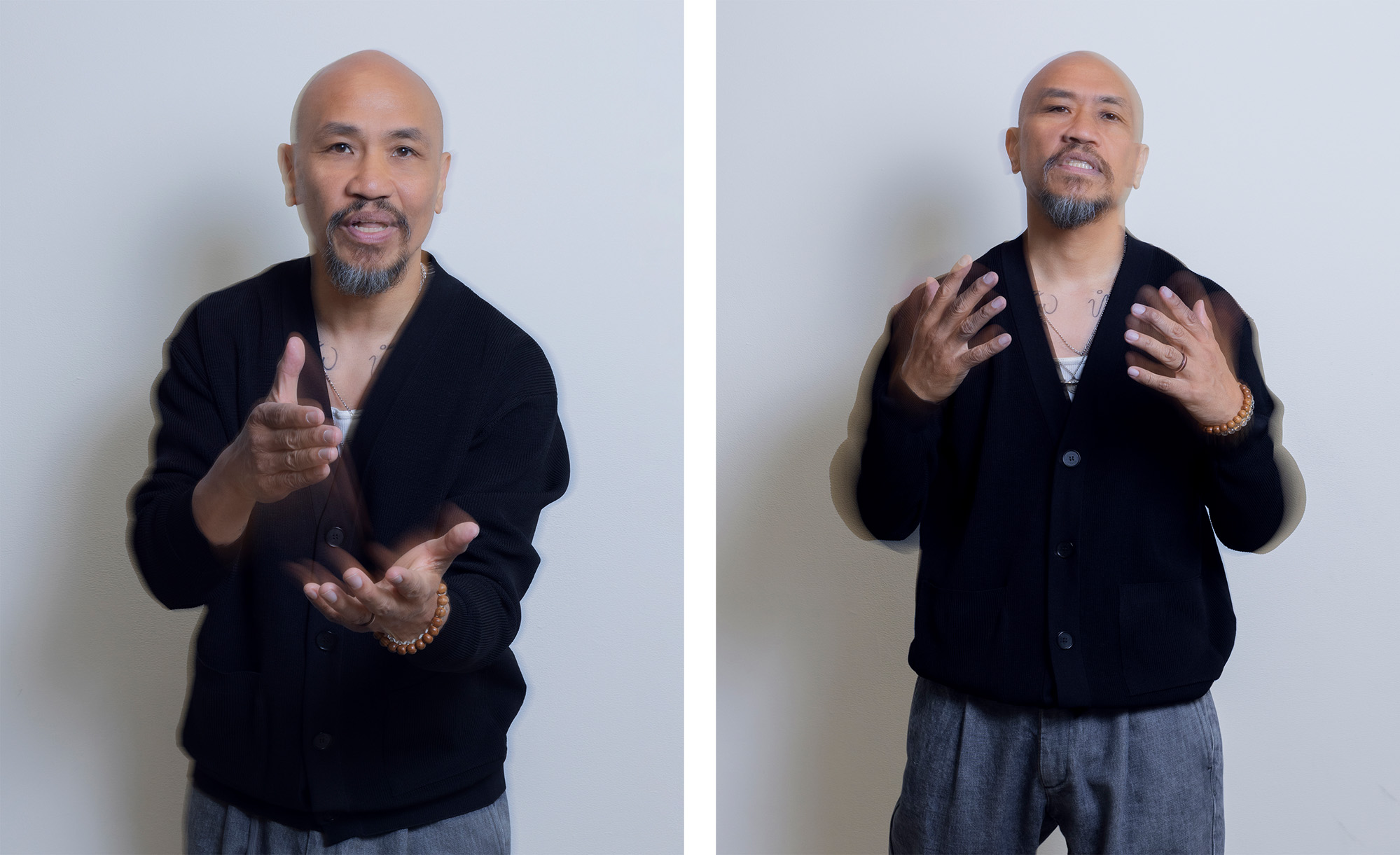
Soft button-up cardigan and black denim cardigan, Herno. Photo: David Sierra
If I could go back in time and visit you as a 16-year-old, what were you like? What were the posters on your wall?
I did not have posters. It’s so wacky because I’m growing up in the 1980s and it’s New Jersey. I grew up in this multiracial neighborhood. There was a Hungarian family on our street that lived in a couple of different houses. The next block over was mostly Black. It was also like the hip-hop era. I was a B-boy, and DJing.
In some way, I can’t imagine having grown up in any other era because the 80s was a time when art and music and literature were trying to think about how all different kinds of references and sources could live together. And I was trying to ask that question myself as a teenager. I didn’t want to divide one self from the other. I ended up doing it anyway, and I’ve spent my life trying to reintegrate all those different parts of my life.
But that 16-year-old me was listening to new wave and Afrika Bambaataa and the Beatles and Franz Schubert and Led Zeppelin and church music and Filipino folkloric music and all this stuff that ostensibly doesn’t belong together. I knew intuitively that there was a magic in bringing all that really disparate stuff together in one place.
You found poetry a little bit later in life, but before you went off to college, did you know what you wanted to study? Was there something that you aspired to? Was there an original game plan?
What I aspired to be was a composer. A classical composer, but I had started having a really deep interest in jazz at that point, too. I started being really curious about bebop. But like a lot of immigrant families, especially if you’re being drawn to the arts, my parents wanted me to do something that was respectable and professional. My dad really wanted me to be a lawyer. My mom was like, as long as you’re happy, but my dad really had the voice of, like, what we were supposed to choose to do. I got admitted to Rutgers University thinking that I was going to be a business major. And because I had a predilection for languages, I thought that maybe I would do international business law, which just cracks me up at this point. I flunked out within a year and a half.
What was challenging for you? Why’d youflunk out?
I got kicked out and then conditionally, if I took these summer classes and had a particular grade, they were going to let me back in. And I took freaking calculus. And the reason I got kicked out in the first place was because I’m cutting class to go play basketball, or go DJ, or go dance—all this sort of “extracurricular stuff,” which actually ended up being part of a lot of the stuff that I teach now in the university.
It’s not that I wasn’t intellectually capable, because when I took that calculus course during the summertime, I just didn’t want to be in a classroom, like cooped up. So I ended up not going to any of the classes, but I studied the book on my own. I passed the class. I taught myself calculus. So it’s not like I didn’t have the intellectual capacity. It’s that I wanted to apply it to making music, making art, and being with other people.
I didn’t know that there was a space available to direct one’s creative energy into an academic setting. And who knows, maybe that wasn’t available in a state university in New Jersey in the 1980s.
Soft button-up cardigan and black denim cardigan, Herno. Photos: David Sierra
And eventually you transferred to Bloomfield College, right? And that’s where you discovered poetry. How did that happen?
Well, I did a little tour of community colleges, continuing my experiments in failure. I hated books. I couldn’t read books. I just felt bored by them. And then I ran into this guy, Carl Cuttita at Union College of Union County, and we read Lolita, we read Hunter S. Thompson, we read Allen Ginsberg. In one of these courses, there was this BOA anthology of contemporary poets and in there was Amiri Baraka and Anne Sexton and Gwendolyn Brooks and Lucille Clifton. I didn’t understand what I was reading, but I was drawn to it. I passed some of the courses there and then I went to Bloomfield College where I really blossomed.
There was this guy, Martin Kalman, who was a freaking genius in the classics and the canon. Dr. Carey taught me Shakespeare and literature from the British Isles. And then I took one creative writing class with Paul Genega, he was a poet, and we’re good friends now. He really opened up my world to the possibility that everything that I wanted to do as a composer I could do with language: that poetry was a composition of sound, fundamentally. So that’s like the CliffsNotes version of how I ended up writing poems.
I think the brilliant thing about Paul is that he had such an open idea of art and poetry. He worked on the catalogue raisonné of Jackson Pollock, too. And so he had a very ecumenical idea of the interplay of different arts. Growing up in the hip-hop era, if you were in a crew, you were always in conversation with people who did graffiti, who DJed, who rhymed, who rocked clothes and danced. And so one form of making always belonged to another constellation of making. So, I felt really lucky that I wound up at Bloomfield College and studied with the people that I studied with, because it was able to accommodate all of my creative impulses and energies.
Do you see poetry as sort of a form of music?
Absolutely. My graduate seminar was on strangeness last semester. I have a bunch of prose writers in that class, not a single poet. Well, not overtly, I’m converting some of them.
I said, you could say the wildest shit. If it’s musical, people are going to ride with you. If the language has music and the music carries a feeling, people are going to ride with you, even though they don’t quite understand what the words are actually saying.
That’s the magic of poetry: it’s its own soundtrack. I was so deep when I wanted to be a composer. I think that I’ve spent my life being an autodidact, too. I studied a lot of music theory and really was trying to listen to, like, McCoy Tyner on the John Coltrane records and trying to figure out Bird’s bebop lines and all that. That whole idea that sound is where the feeling gets carried through and poetry being an art form of sound, it just resonated with me.
And then you went and got your MFA, right?You went to Sarah Lawrence College. Were you studying poetry there specifically? What was that like?
Again, it’s like my body knew that I needed to be with all the weirdos. And Sarah Lawrence is another place where you can experiment and do a lot of wacky things. The MFA program there, it’s not conservative, it’s like American contemporary poetry. Marie Howe was my first workshop teacher. She just won the Pulitzer Prize recently. And Tom Lux, Vijay Seshadri, Suzanne Gardinier, who’s like more out. But there’s a way that the whole ethos of the place was like, “Okay, you’re going to study poetry. You’re going to learn how to write publishable poems.” But I knew I was an outsider with all this other spoken-word-ish. Even though I didn’t really consider myself a slam or spoken-word person, I knew that I was operating inside of the oral tradition. It was a good place for me because of all of that traditional study of things like scansion and modernism and the lyric narrative. It was all great for my chops. I could apply that to the stuff that I wanted to do out loud and with collaborations with dancers, musicians, and visual artists. I don’t think that that happens in a lot of MFA programs. It’s actually a struggle in the MFA program where I’m teaching now. I have to do all of that groundwork for an inclusive artistic culture in which poetry sits as a hub. Whereas at places like Naropa and Sarah Lawrence, that’s just how it works. But most MFA programs, it’s like, you’re a writer. And not only are you a writer, you’re doing one genre.
So, Sarah Lawrence was a great place for me to be able to just break down the boundaries of disciplines.
Herringbone wool coat, merino wool collared shirt, and wool trousers, Herno. Photo: David Sierra
You won an award for your first book, Uprock Headspin Scramble and Dive. Tell me about that book and where your head was at at the time.
That’s a beautiful question to go back like more than 25 years at this point and think about those poems and where I was at. My mom died in 1995. I finished my MFA in 99. That book came out in 2003. And I trace the timeline, in part, because when my mom died in the mid 90s, it was like continuous grief, continuous mourning. I didn’t have the vocabulary for it at the time. Poetry was a place where I could channel that mourning. What’s incredible looking back now at that book is that I was trying to do two things at once.
I was trying to articulate this incredible loss of my mother who loved me so deeply and whom I loved. And I was trying to talk to the guys that I grew up with in New Jersey. Some of them were gang-related, a friend of ours died in prison.
We grew up on this border of working-class immigrants and solidly middle-class immigrants. Again, this in-between space, but certainly not the folks who were reading The New Yorker or the Paris Review. I didn’t even know how or why that stuff was important.
All I knew was that these lyric narrative poems had music and magic. And the experiment was, well, what if I put our experience in there? What if I put our own agitation and anger and grief and celebration and dancing inside of these poems, man?
I knew, too, that the vast majority of the people that I grew up with, my family included—my cousins who came from the Philippines or Hawaii—were not going to read books, let alone a book of contemporary poetry. And if they decide to pick up my book, let them see something that they might recognize. And that’s where a lot of that book came from.
I also wanted to make space for a hip-hop sensibility, if not a direct aesthetic. I wanted that energy, where I felt like I had made one of my first homes for my imagination to be part of the engine of the book. I’m really proud. It was put out by a literary press—you look back to the early 2000s, there were not a lot of literary presses that were interested in publishing that kind of work.
I just saw my ex, actually, the other day, I was dating her at the time when I was writing those poems. She lives in California, but she came out and she’s like, “Okay, Mr. Guggenheim,” having come all this way. She said to me, “You know what’s amazing? It’s like you never gave up. You stayed true to yourself.” I guess I could be a stubborn person. My wife will say, “Yeah, you’re stubborn.” But there was stuff that I wanted my work to do and to be in conversation with and things that I wanted to do for myself. While I’ve made a lot of changes throughout my career, that book marks a throughline that you can trace all the way, even to the stuff that I want to do at the museum this year.
Obviously, you’ve published a bunch of different collections in books. What do you see your poetry to be about?
The most accurate and pithy way that I can articulate what my poems are about is something about the brokenness of our world and the self and how sacred all of it is. I think that learning how to dig through crates of records and find sounds that nobody’s really paying attention to and putting them together with other sounds, dealing with fragments, dealing with things that are inherently broken and learning to put them together. And then seeing a room full of people dance their hearts out, gave me the idea that there’s a relationship between the fissures of our own world and the sacredness of our own being together. I think that that might be true. I would love to believe that that’s what my work is about, or aspires to.
You’re probably best known for the collectionBrooklyn Antediluvian, which won you the Guggenheim Fellowship. Tell me about this work, what is it about, and why you think it struck a chord?
The cynical part of me says that it struck a chord because Brooklyn was hip at the time. It still is, but it was on that rise. So anything that had Brooklyn, people were like… It’s funny because the book itself is poking fun at people’s idea of Brooklyn being a mecca for the hip. The whole idea of a “Brooklyn Antediluvian” is that there was a Brooklyn before you got here. There was a Brooklyn before I got there. There was a Brooklyn before that, and a Brooklyn before that, and a Brooklyn before that.
What year was this?
The book itself came out in 2016. I wrote a lot of those poems over almost a decade of writing, 2008 to 2016. So the idea of the antediluvian, meaning before the Flood in the Bible, is usually a pejorative term for something that’s out of date, but it’s a language that’s used to reinforce hipness.
So, I wanted to flip that a little bit and talk about the old being important. It traces my parents’ own arrival in Brooklyn, my move into Brooklyn 40 years after they had gotten there. Also, just the etymology of the word antediluvian and the idea of a flood. I had been in one of the most major typhoons in the Philippines in 2008, and the imagery and the experience of literal floods in the streets of Manila and Quezon City are in that. There’s also the flood of feeling, and just being a man of color, and having to restrain that dimension of myself, of having this powerful feeling. It’s floods on a lot of different levels. It’s time on a lot of different levels.
The title poem itself is this long poem, which is a meditation about history and naming and names. And names actually end up sort of flooding the borough of Brooklyn, too, in the poem.
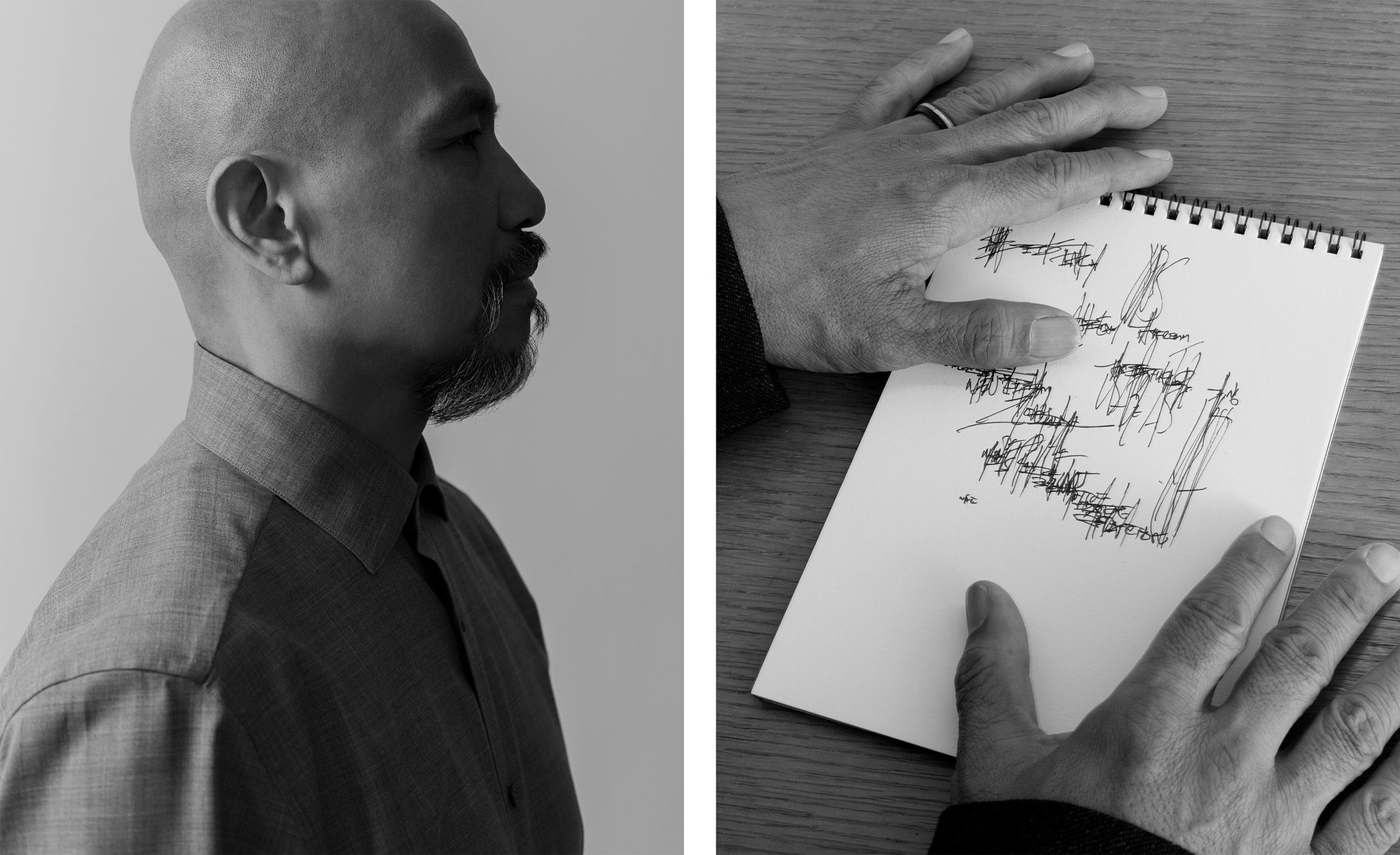
From left: Merino wool collared shirt and wool trousers, Herno; the poet’s notebook. Photos: David Sierra
That brings us to the Guggenheim Poet-in-Residence program. Your project revolvesaround water. So tell us about this project, what it’s titled, and how it all comes together.
So, the proposal is called “The Water Listeners,” and the whole idea was of folks listening somehow—from, around, through—this universal element, water, and something that’s sacred, something that holds all of our mythologies, that has this destructive force and this creative force, that is part of the Middle Passage, that is part of our birth and our death, and everybody having a relationship to water, and the whole world literature built around water.
So, I wanted to create opportunities for visitors to engage with poetry and water and poets and music. So, the hope right now, we’re planning a celebration, a ceremony that gets us together around water. We want to invite youth, elders, folks from New York, folks visiting New York, to come to the museum. Hopefully they’re going to be able to make these little artifacts around water, and maybe even flowers that refer to the “Brooklyn Antediluvian” poem, which is like a flood of roses, to make these little flowers, these little pieces of language, and put them all together over the course of these months. They will comprise an offering to water about our future of water, in a big ritual in December. So everybody who visits the Guggenheim can essentially participate in the making of this ceremony that celebrates water at the end of my residency.
Poetry is one of those art forms that always struggles to be respected and understood fully. I think in today’s sort of subscription culture, it’s something that people can’t wrap their brains around, especially from an Americancapitalist point of view, which is not a term I like to throw around very often. In today’s social media age, and now we’re entering into the age of AI, how would you describe, what is poetry today versus when you started?
I don’t know. I’m not great at keeping up.
That’s an honest answer.
I’m closing in on 60, and I’m embracing the archetypal uncle. There are things, not necessarily objects, but there are ways of being in the world, in language, in sound, with each other, with the land, that I’m just trying to preserve. I think that that’s one of the things is, like, I’m not even an expert on AI, but it just feels like the language that gets generated out of that is purposefully and cynically separated from the land. We think about poetry, we think about language as a tool to describe the land. But language is sound. And our ecology is also made of sound. And so for us as human beings, the sounds that we make are a part of our ecology.
This is my hypothesis: the biodiversity of the world, the gross number, is diminishing. The linguistic diversity of the world is also diminishing. There’s a researcher out at Stanford University, I believe, who saw that there is a gross correlation between the rate of diminishment of biodiversity and linguistic diversity. In fact, the places on the planet that are the most biodiverse are also the most linguistically diverse, mostly.
My sense as a poet who’s deeply interested in the local, is that this sonic thing that we call poetry, which also names the world, might be part of the way that we preserve the planet. That we have to pay attention, that we have to name, that we have to listen to one another, to our own surroundings, to the water, to the weather. And that process of engagement, that process of attention, that cognitive process of trying to name what the hell it is that we are actually witnessing. What if that’s part and parcel of the way that the ecology works to begin with? I feel like I’m not against technology by any stretch, but if it severs us from that relationship to the land, it’s bad news to me.
That being said, there’s so much art and so many artists who are out here trying to be with each other. And so, I don’t know what poetry is today, but I know that there’s a living community that’s trying to gather around poetry and preserve that dimension of it.
If I asked you, what is poetry?
I can give you the classical answer. The word poetry comes from the Greek word for making. So, it’s the making of anything. The making of a garden, the making of a poem and language, the making of a relationship, the making of a meal—but not any making, I think. The making that begins with a curiosity, and a curiosity that becomes a question, and a question that clarifies itself through the process of making. I think that’s what poetry is. I won’t say authoritatively, but that’s how I think about what poetry is.
Do you have any advice for aspiring poets?
Have a relationship with your fear, so that you can have a relationship with what you don’t have words for. Learn how to be still enough to try to find the words for the thing that you can’t name. Fail at naming it, and name it again and again.